Introduction
Expandable container houses and folding houses are two common modular housing options for overseas buyers.
Both are factory-produced, transportable, and used for temporary or project-based buildings. However, they are not the same product. Their structure, space performance, loading method, installation process, layout flexibility, and suitable applications are different.
At Sinopala, buyers usually compare these two products when planning worker accommodation, site offices, rental units, farm housing, project camps, emergency housing, or modular living units.
This guide explains the key differences between expandable container houses and folding houses from a practical B2B purchasing point of view.
What Is an Expandable Container House?
An expandable container house is a modular building that is transported in a compact form and opened on site to create a larger interior space.
Depending on the model, an expandable container house may include:
- steel frame
- expandable side sections
- wall panels
- roof and floor system
- doors and windows
- bathroom
- kitchen or kitchenette
- bedroom or living area
- electrical and plumbing preparation
- interior finish options
Expandable container houses are often selected when buyers need more usable interior space after installation.
Common uses include:
- single living units
- rental rooms
- family-style accommodation
- farm housing
- site offices
- office-living units
- tourism accommodation
- remote project housing
For buyers focusing on living comfort and internal layout, expandable container houses are usually easier to plan than compact temporary units.
What Is a Folding House?
A folding house is a modular building designed to be transported in a folded form and unfolded on site.
Depending on the model, a folding house may include:
- steel frame
- folding or hinged structure
- wall panels
- roof and floor system
- doors and windows
- locking or fixing points
- optional electrical routes
- optional bathroom or shower system
- optional interior finish
Folding houses are often selected when buyers need compact transport, simple layout, faster site setup under prepared conditions, and batch deployment.
Common uses include:
- worker accommodation
- student dormitories
- site offices
- temporary project housing
- modular camps
- farm support rooms
- emergency support housing
- storage or utility rooms
For buyers still learning the product, the article about what a folding house is can help explain the basic structure before comparing it with expandable models.
Main Structural Difference
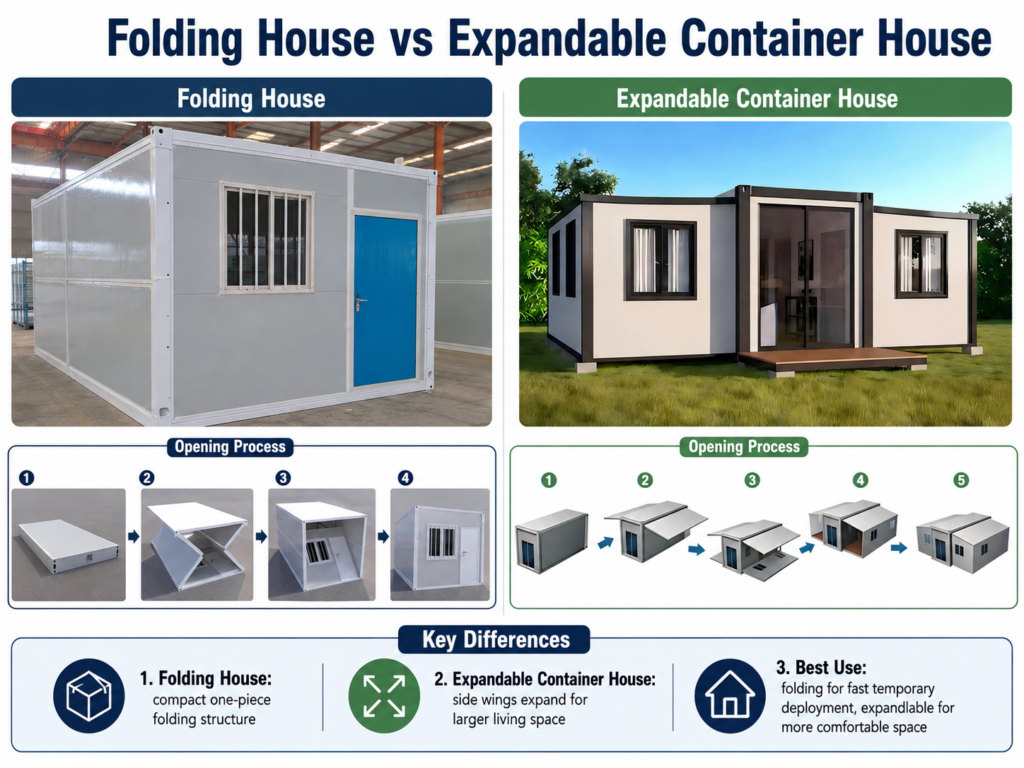
The main difference is how the house opens.
An expandable container house usually opens outward to create more usable interior space after delivery.
A folding house usually unfolds from a compact folded structure into a complete unit.
This means the engineering focus is different.
Expandable container houses focus more on:
- expanded living space
- side-section opening
- interior layout
- bathroom and kitchen planning
- residential comfort
- expanded width and site clearance
Folding houses focus more on:
- compact folded transport
- folding frame system
- hinge and connection points
- fast batch setup under prepared conditions
- simple accommodation or project use
- loading efficiency
For more technical details about folding models, buyers can review the folding container house structure guide before choosing.
Space and Layout Difference
Expandable container houses usually provide more interior space after opening.
This makes them more suitable for:
- one-bedroom layouts
- two-bedroom layouts
- living room layouts
- bathroom and kitchen combinations
- family accommodation
- rental units
- office-living units
- tourism accommodation
Folding houses are usually more compact and practical.
They are often suitable for:
- dormitory rooms
- site offices
- temporary worker accommodation
- camp units
- storage rooms
- emergency housing
- basic project support rooms
If the buyer needs more comfortable living space, an expandable container house may be more suitable.
If the buyer needs many simple units for a project site, a folding house may be easier to organize.
For detailed layout planning, buyers can review expandable container house floor plans before confirming the final design.
Transportation and Loading Difference
Transportation is one of the biggest practical differences between the two products.
Folding houses are designed to be compact when folded, so multiple units may be loaded together depending on size, packing method, and container type.
Expandable container houses also need shipping planning, but their packed structure, loading quantity, and transport method are different from folding houses.
Before comparing transport cost, buyers should confirm:
- folded or packed size
- expanded size if applicable
- loading quantity
- packing method
- container type
- gross weight if needed
- destination port
- local delivery route
- unloading equipment
- EXW or FOB trade term
- whether a shipping agent is arranged
Buyers should not assume one product always has lower shipping cost. The actual logistics cost depends on size, quantity, loading plan, destination port, freight market, and local delivery conditions.
For export planning, the container house shipping guide should be reviewed before comparing quotations.
Installation Difference
Both expandable container houses and folding houses are faster to set up than many traditional construction methods, but the installation steps are different.
An expandable container house may require:
- unloading and positioning
- opening the expandable sections
- checking side supports or structure
- fixing and sealing
- bathroom or kitchen connection if included
- electrical and plumbing connection
- final inspection
A folding house may require:
- unloading and positioning
- opening the folded structure
- aligning wall and roof panels
- fixing connections
- checking hinges or locking points
- sealing checks
- utility connection if included
- final inspection
A basic unit may be opened quickly under prepared site conditions, but full project readiness depends on foundation, unloading equipment, local workers, water, electricity, drainage, interior setup, and local approval.
For folding models, buyers can review folding container house installation before planning site work.
Foundation and Site Requirements
Both product types need proper site preparation.
Buyers should confirm:
- level ground
- suitable foundation points
- drainage direction
- unloading space
- crane or forklift availability
- truck access
- expanded clearance if using expandable units
- anchoring method if required
- local labor arrangement
- utility connection points
- nearby obstacles such as walls, trees, wires, or buildings
Expandable container houses need enough side clearance for opening.
Folding houses need enough working space for unfolding, positioning, and fixing.
For site cost planning, buyers can review container house installation cost before confirming the total project budget.
Cost Difference
This article is not mainly a price comparison article, but cost is still important.
In general, the final cost depends on:
- product type
- size
- steel frame
- wall panels
- bathroom or kitchen configuration
- interior finish
- electrical and plumbing system
- order quantity
- packing and loading
- shipping arrangement
- EXW or FOB trade term
- foundation and local installation
A folding house may be more suitable when the project needs many simple accommodation units.
An expandable container house may be more suitable when the project needs larger interior space and more residential comfort.
The cheaper option depends on configuration, quantity, destination port, site condition, and intended use.
For deeper price comparison, buyers can review expandable vs folding container houses before making a budget decision.
Application Difference
Expandable container houses are often suitable for:
- residential living units
- rental accommodation
- farm housing
- tourism cabins
- office-living units
- family-style layouts
- remote project housing
- larger living layouts
Folding houses are often suitable for:
- worker accommodation
- student dormitories
- site offices
- temporary project housing
- modular camps
- emergency support housing
- storage support rooms
- basic accommodation at scale
The decision should start from the project use, not from product photos.
A buyer planning rental housing may care more about comfort, layout, bathroom, kitchen, and appearance.
A buyer planning worker dormitories may care more about quantity, loading plan, installation speed under prepared conditions, and simple maintenance.
Which One Should You Choose?
Choose an expandable container house if you need:
- more usable interior space
- better residential layout
- bathroom and kitchen planning
- family-style accommodation
- rental or tourism use
- office-living function
- larger living comfort after unfolding
Choose a folding house if you need:
- compact transport
- batch accommodation
- simple site office
- worker dormitory
- temporary project housing
- modular camp use
- quicker setup under prepared conditions
- easier storage and relocation planning
The final choice should be based on project purpose, size, quantity, layout, budget, destination port, site access, installation conditions, and expected project duration.
What Buyers Should Confirm Before Ordering
Before choosing between expandable container houses and folding houses, buyers should confirm:
- intended use
- project country or destination port
- required size
- estimated quantity
- number of users
- layout requirements
- bathroom, shower, kitchen, office, or dormitory needs
- wall panel and insulation requirements
- expected project duration
- packing and loading requirements
- preferred trade term: EXW or FOB
- whether a shipping agent is arranged
- site access condition
- unloading equipment
- foundation and utility connection plan
With this information, the supplier can recommend a more suitable product type instead of only quoting a general price.
Conclusion
Expandable container houses and folding houses are both useful modular building solutions, but they solve different project problems.
Expandable container houses focus more on expanded interior space, residential layouts, and living comfort.
Folding houses focus more on compact transport, simple accommodation, batch deployment, and temporary project use.
Neither option is always better. The right choice depends on project use, quantity, layout, transport plan, installation site, budget, and local conditions.
For overseas B2B buyers, the safest approach is to compare structure, layout, loading, EXW / FOB responsibility, installation requirements, and total project cost before ordering.
Need Help Comparing Expandable Container Houses and Folding Houses?
If you are comparing expandable container houses and folding houses for a project, Sinopala can help review your requirements before quotation.
To recommend a suitable product type, please share:
- intended use
- project country or destination port
- required size
- estimated quantity
- number of users
- layout requirements
- bathroom, shower, kitchen, office, bedroom, or dormitory needs
- wall panel and insulation requirements
- preferred trade term: EXW or FOB
- whether you already have a shipping agent
- site access and unloading conditions
- foundation and utility connection plan
Contact Sinopala:
WhatsApp: +86 150 1103 0786
Email: info@sinopala.com
Website: www.sinopala.com