Introduction
When buyers consider an expandable container house project, one common question is whether the purchase is worth the investment.
The answer depends on the project use, local market demand, total cost, site conditions, installation preparation, operating plan, and long-term maintenance. An expandable container house may be a practical option for some projects, but ROI should not be judged only by the factory price or product photos.
For overseas buyers, the real investment decision should include product configuration, EXW or FOB term, shipping, customs clearance, destination port charges, inland delivery, unloading, foundation, installation, utility connection, local permits, maintenance, and operation costs.
This guide explains how to evaluate the investment value of expandable container houses in a practical and cautious way.
What ROI Means for Expandable Container Houses
ROI means return on investment. In simple terms, it compares the value or income generated by a project with the total cost invested.
For expandable container houses, ROI may be considered in different ways depending on the project:
- Rental income from temporary accommodation or short-term stays.
- Cost control for worker accommodation or project camps.
- Faster project deployment compared with some local construction options.
- Flexible use for farms, offices, temporary housing, emergency support, or site facilities.
- Potential reuse or relocation in some project conditions.
However, ROI is not guaranteed. It depends on local demand, project management, legal approval, operating costs, installation quality, maintenance, and how the unit is used after delivery.
A buyer should treat ROI as a project evaluation question, not as a fixed promise.
Key Factors That Affect ROI
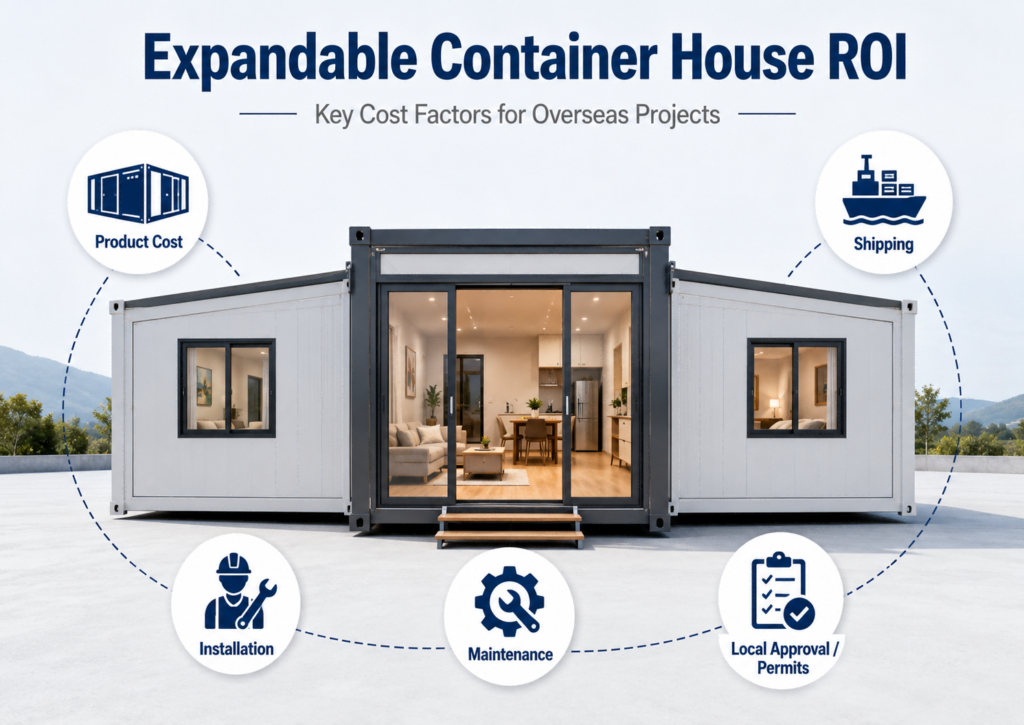
The investment value of an expandable container house depends on several practical factors.
The most important factors include:
- Product size and layout.
- Wall panel material and insulation thickness.
- Bathroom, kitchen, electrical, and plumbing configuration.
- Quantity and order scale.
- Packing size and loading plan.
- EXW or FOB quotation scope.
- Ocean freight and destination port cost.
- Local delivery and unloading cost.
- Foundation and installation preparation.
- Utility connection.
- Local permits and building requirements.
- Maintenance and repair plan.
- Rental or operating demand in the local market.
If these factors are not calculated together, the ROI estimate may be unrealistic.
Factory Price Is Only One Part of the Investment
Many buyers first ask for the unit price. This is understandable, but the unit price is only one part of the total project cost.
For overseas orders, buyers should also consider:
- Configuration cost.
- Interior layout and wet-area cost.
- Packing and loading cost.
- EXW or FOB trade term.
- Ocean freight.
- Customs clearance.
- Destination port charges.
- Inland transport from port to site.
- Unloading equipment.
- Foundation work.
- Local installation labor.
- Electrical, water, and drainage connection.
- Local approval or inspection requirements.
- Furniture, air-conditioning, and other site accessories if needed.
An expandable container house with a lower factory price may not always create a better investment result if shipping, installation, or local preparation costs are not planned correctly.
When Expandable Container Houses May Create Value
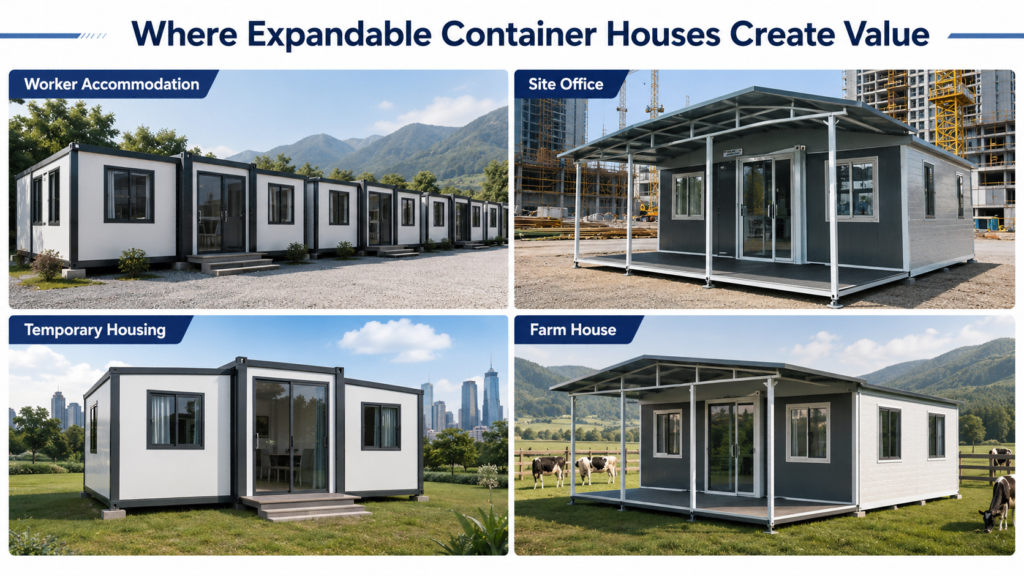
Expandable container houses may create value when the project needs a compact shipping form and a larger usable space after installation.
They are often considered for:
- Worker accommodation.
- Temporary housing.
- Farm houses.
- Site offices.
- Remote project accommodation.
- Backyard or auxiliary units where local rules allow.
- Rental units in markets with real demand.
- Emergency support housing.
- Small commercial or office use.
- Project camps.
For project buyers, the value may come from practical use rather than resale speculation. If the unit solves a real space problem, supports a project schedule, or helps provide accommodation where local construction is difficult, the investment may be more reasonable.
Rental Income Depends on Local Market Demand
Some buyers consider expandable container houses for rental use. This may be possible in certain markets, but rental income depends heavily on local conditions.
Before planning rental income, buyers should check:
- Whether container houses are allowed locally.
- Land use and zoning requirements.
- Building permit requirements.
- Utility connection rules.
- Local rental demand.
- Target users.
- Seasonal occupancy.
- Insurance requirements.
- Maintenance cost.
- Cleaning, management, and repair cost.
- Competition from hotels, apartments, cabins, or other rental options.
Sinopala can provide product and export support, but rental income, occupancy rate, resale value, and local approval depend on the buyer’s market and operation.
Cost Control for Project Accommodation
For construction, mining, farm, and infrastructure projects, expandable container houses may be evaluated differently from rental projects.
In these cases, buyers may care more about:
- Providing worker accommodation.
- Reducing dependency on local temporary buildings.
- Improving site organization.
- Creating office or management space.
- Supporting remote project deployment.
- Using units for more than one project if relocation is practical.
The return may not come from direct rental income. It may come from project convenience, schedule support, accommodation availability, and better control over site facilities.
Even in these cases, buyers should still calculate total project cost, including shipping, local delivery, foundation, installation, maintenance, and relocation if reuse is planned.
Expandable vs Folding Container Houses for Investment
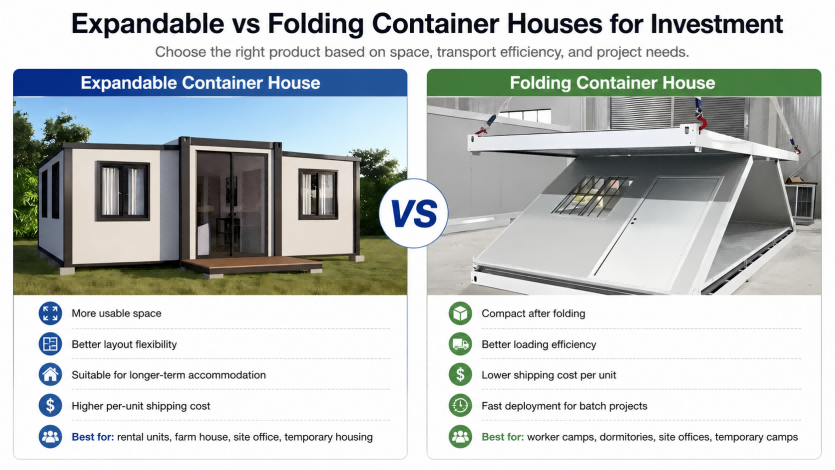
Folding container houses and expandable container houses may serve different investment goals.
Expandable container houses usually provide more usable interior space after installation. They may be suitable when the buyer needs a wider layout, stronger living-space impression, or a more complete accommodation function.
Folding container houses are usually more focused on compact transport and batch deployment. They may be suitable for dormitories, temporary camps, worker rooms, and projects where loading efficiency is important.
The better choice depends on the project:
- Choose expandable container houses when usable space and layout comfort are more important.
- Choose folding container houses when bulk delivery, compact transport, and fast project deployment are more important.
- Compare both when the project involves accommodation, offices, bathrooms, kitchens, and support facilities.
- A good investment decision should compare product type, shipping cost, site setup, use period, and operating plan together.
Risks Buyers Should Consider
Expandable container houses are not risk-free investments.
Before placing an order, buyers should consider:
- Local building regulations.
- Land ownership or land-use permission.
- Foundation requirements.
- Climate and insulation needs.
- Wind, snow, fire, and safety requirements.
- Utility connection.
- Shipping and port cost changes.
- Local labor and installation capability.
- Maintenance responsibilities.
- Market demand if used for rental.
- Insurance and financing limitations.
- Resale uncertainty.
A project may look attractive when only the product price is considered, but the actual result depends on whether these risks are checked early.
How to Evaluate Whether It Is Worth It
Before deciding whether an expandable container house is worth the investment, buyers should prepare a basic project evaluation.
Important questions include:
- What is the intended use?
- How many units are needed?
- Where is the project located?
- Is local approval required?
- What size and layout are needed?
- Does the unit need toilet, shower, kitchen, or full interior configuration?
- What insulation level is required?
- What is the expected use period?
- Will the unit be rented, used internally, or moved between projects?
- What is the destination port?
- Is the quotation EXW or FOB?
- Does the buyer have a shipping agent?
- Is the site ready for unloading, foundation, installation, and utility connection?
- Who will manage maintenance after installation?
These questions help buyers compare total cost and realistic project value instead of relying on a simple ROI percentage.
What SINOPALA Can Support
SINOPALA can support overseas buyers with product and project information before production and shipment.
Our support may include:
- Expandable container house configuration discussion.
- Size and layout confirmation.
- Wall panel, insulation, door, window, bathroom, kitchen, and electrical option discussion.
- EXW or FOB quotation based on confirmed requirements.
- Packing and loading information.
- Basic shipping-related documents.
- Production and loading photos when needed.
- Installation guidance documents or videos when available.
- Comparison with folding container houses or modular container houses when the buyer is not sure which type is suitable.
Sinopala does not guarantee rental income, local approval, resale value, tax benefits, or fixed ROI. These depend on the buyer’s local market, project execution, and operating plan.
Information Needed for an Investment Evaluation
To help check whether an expandable container house is suitable for your project, please send:
- Project country and destination port.
- Intended use.
- Required quantity.
- Preferred size, such as 10ft, 20ft, 30ft, or 40ft.
- Layout requirements.
- Whether toilet, shower, kitchen, or office function is needed.
- Wall panel and insulation requirements.
- Electrical standard and voltage.
- Expected use period.
- Preferred EXW or FOB term.
- Whether you have a shipping agent.
- Site condition and unloading plan.
- Local installation and utility connection preparation.
- If it is for rental, your target customer type and local approval status.
With this information, SINOPALA can help check the suitable product configuration, loading plan, and quotation scope.
Conclusion
Expandable container houses can be a practical investment option for some projects, but ROI is not automatic.
The result depends on total project cost, local approval, market demand, site preparation, installation quality, maintenance, and how the house is used after delivery.
For overseas buyers, the right question is not only “How much is one unit?” A better question is: “Does this product fit my project use, budget, site condition, and local market?”
If you are evaluating an expandable container house project, share your project details with SINOPALA. We can help check the configuration, EXW or FOB quotation, loading plan, and project suitability based on your requirements.
Contact SINOPALA:
WhatsApp: +86 150 1103 0786
Email: info@sinopala.com
Website: www.sinopala.com