Introduction
Container houses and prefab houses are both factory-made building solutions, but they are not the same product. The best choice depends on project budget, installation speed, transport limits, site conditions, local approval, and long-term use.
For contractors, camps, dealers, and commercial project buyers, the right option is not always the cheapest one. A container house may be better for fast deployment, repeatable units, worker accommodation, site offices, and export projects. A prefab house may be better for larger permanent buildings or projects that need more architectural customization.
This guide compares container houses and prefab houses by structure, production method, transportation, installation, cost, layout, and best use cases.
Container House vs Prefab House: Quick Comparison
| Factor | Container House | Prefab House |
|---|---|---|
| Product type | Specific modular container-based unit | Broad category of factory-made buildings |
| Structure | Steel frame or container-style modular frame | Steel, wood, concrete, panelized or mixed systems |
| Transport | Designed for export, folding, flat pack or modular shipping | Shipped as panels, frames, modules or components |
| Installation | Usually faster for repeatable temporary or semi-permanent projects | May need more site assembly and local labor |
| Cost control | Easier to compare by unit, size, quantity and configuration | Depends more on design, materials and site work |
| Best for | Camps, site offices, worker housing, remote projects, temporary facilities | Permanent buildings, villas, schools, offices and custom projects |
What Is a Container House?
A container house is a modular building unit based on a container-style steel frame or container-based structure.
Depending on the product type, a container house may be supplied as:
- expandable container house
- folding container house
- modular container house
- flat pack container unit
- container house toilet or shower unit
Container houses are commonly used for:
- worker accommodation
- construction site offices
- temporary housing
- farm housing
- mining camps
- remote project facilities
- rental units
- portable toilets and showers
- storage or support rooms
Modern container houses can include wall panels, roof and floor systems, doors, windows, electrical routes, bathroom areas, kitchen areas, and interior finishes depending on the order configuration.
For buyers comparing size options, the expandable container house size guide can help review common dimensions and layout planning before quotation.
What Is a Prefab House?
A prefab house, or prefabricated house, is a building made from factory-produced components that are transported to the site and assembled there.
Prefab houses may use different systems, such as:
- light steel frame structures
- wood-frame structures
- concrete panels
- sandwich panel systems
- modular building sections
- panelized wall and roof systems
This means “prefab house” is a broader term than “container house.”
A container house can be considered one type of prefabricated modular building, but not every prefab house is a container house.
Prefab houses are often used for residential buildings, commercial buildings, offices, schools, accommodation projects, and other modular or semi-permanent construction needs.
Main Difference: Product Category
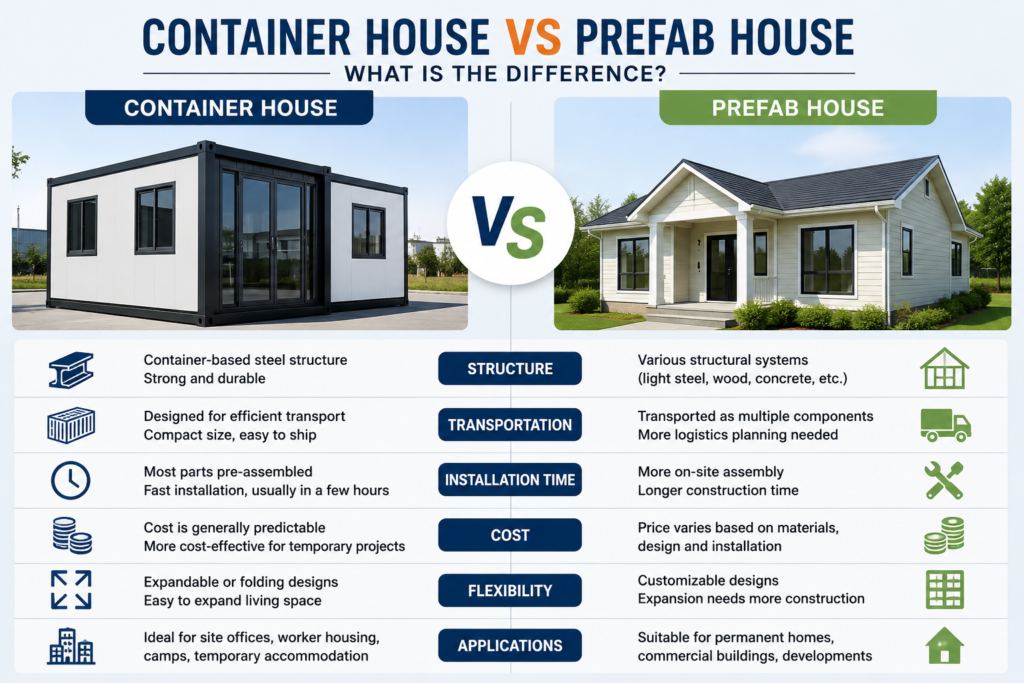
The biggest difference is category.
A prefab house is a broad building category. It can include many different factory-made construction systems.
A container house is a more specific product type. It usually has a container-style steel structure, transportable unit form, and modular layout.
For example:
- an expandable container house is a container-based modular unit
- a folding container house is a transportable folding unit
- a flat pack container house is a container-style structure assembled on site
- a light steel prefab villa may be prefabricated, but it is not necessarily a container house
So the question is not only “container house or prefab house.” Buyers should first confirm what type of prefab system they are comparing.
Structure and Materials
Container houses usually focus on steel-frame or container-based modular structures.
Important parts may include:
- steel frame
- roof and floor system
- wall panels
- doors and windows
- connection parts
- folding or expanding mechanism if applicable
- anti-rust treatment
- waterproofing and sealing
Prefab houses may use different materials depending on the system. Some use steel frames, some use wood, some use concrete panels, and some use lightweight wall systems.
This difference matters because structure affects durability, transport method, installation process, maintenance, and local approval.
For container house buyers, it is important to confirm drawings, wall panel type, steel frame details, installation guidance, and material specifications before ordering.
Factory Production Method
Both container houses and prefab houses may be produced partly in a factory, but the production method is different.
Container houses are often prepared as modular units or compact transportable structures. Depending on the model, the factory may prepare the frame, panels, doors, windows, bathroom area, electrical routes, and some interior elements before shipment.
Prefab houses may be produced as separate wall panels, roof panels, frames, modules, or building components. These parts are then transported and assembled at the project site.
For overseas buyers, this affects:
- packing method
- loading quantity
- installation workload
- local labor requirement
- site assembly time
- quality control
- rework risk
- final project cost
Container houses are often easier to evaluate as repeatable units, while prefab houses may require more detailed site assembly planning depending on the system.
Transportation Difference
Transportation is one of the most important differences.
Container houses are usually designed with export and relocation in mind. Folding, expandable, and flat pack container houses may be transported in compact forms depending on the model.
Before shipping container houses, buyers should confirm:
- packing dimensions
- loading quantity
- gross weight if needed
- destination port
- EXW or FOB quotation term
- whether a shipping agent is arranged
- local delivery route
- crane or forklift availability
- site access condition
Prefab houses may be shipped as panels, frames, or building components. This can be flexible, but it may require more sorting, site storage, local assembly work, and installation management.
For overseas projects, buyers should review the container house shipping guide before comparing total delivery cost and responsibility.
Sinopala currently mainly provides EXW and FOB quotations. Under these terms, ocean freight, customs clearance, destination port charges, local delivery, and site unloading are usually arranged by the buyer or the buyer’s shipping agent.
Installation Difference
Container houses often reduce part of the on-site construction work because many components are prepared before delivery.
For folding or expandable container houses, the site work may include unloading, positioning, opening or unfolding, leveling, fixing, sealing checks, and utility connection.
As a general reference, a standard folding or expandable container house may be opened and basically positioned within a few hours when the foundation is ready, unloading equipment is available, and workers are familiar with the installation steps.
However, this does not mean the whole project is finished within a few hours. Full setup may still include foundation, electrical connection, water supply, drainage, bathroom or kitchen setup, inspection, and cleaning.
Prefab houses often require more on-site assembly because panels, frames, roof systems, and interior parts may need to be connected on site.
Buyers should review container house installation cost and site preparation requirements before comparing the real project timeline.
Foundation and Site Work
Both container houses and prefab houses need proper site preparation.
Common site work may include:
- ground leveling
- foundation preparation
- drainage planning
- access road checking
- unloading space preparation
- crane or forklift arrangement
- electrical connection
- water supply
- sewage or drainage connection
- local approval if required
Container houses may need a simpler foundation in some temporary or semi-permanent projects, but this depends on product type, site condition, local rules, unit size, and project duration.
Prefab houses may need more traditional foundation or structural preparation depending on the design and local building requirements.
Buyers should not assume either option can be placed directly on unstable ground.
Cost Difference
It is risky to say that container houses are always cheaper than prefab houses.
The total cost depends on:
- product type
- size
- materials
- wall panels
- structure
- layout
- bathroom and kitchen configuration
- interior finish
- order quantity
- packing method
- shipping cost
- local delivery
- foundation
- installation labor
- utility connection
- local approval
Container houses may be more predictable when buyers need repeatable units, temporary accommodation, site offices, worker housing, or project camps.
Prefab houses may cost more or less depending on the material system, design complexity, local labor, and site assembly requirements.
For price comparison, buyers should compare total project cost, not only unit price.
For B2B buyers, the real comparison should include unit price, packing quantity, EXW/FOB terms, shipping, local delivery, foundation, installation labor, and utility connection.
For a detailed price breakdown, buyers can also review our expandable container house price guide for 20ft and 40ft cost factors, EXW/FOB terms, loading quantity and shipping considerations.
Layout and Customization
Container houses support different layouts, but the layout must fit the product structure.
For example, expandable container houses may support bedrooms, living areas, bathroom, kitchen, and office-living layouts after unfolding. Folding container houses may be better for compact transport and repeated temporary use. Modular container houses may be used for camps, offices, dormitories, and project facilities.
Prefab houses may allow more architectural design flexibility, especially for permanent residential or customized commercial projects.
However, more customization usually means more drawing work, production coordination, site assembly, installation labor, and approval requirements.
For container house layout planning, buyers can review expandable container house floor plans before confirming the final design.
Application Difference
Container houses are often suitable for:
- temporary accommodation
- worker dormitories
- construction site offices
- mining camps
- farm housing
- remote project facilities
- emergency support housing
- portable toilets and showers
- rental units
- project-based modular housing
Prefab houses may be suitable for:
- permanent residential homes
- larger commercial buildings
- customized villas
- schools or offices
- semi-permanent buildings
- architectural projects with more design requirements
This does not mean one is always better. The right choice depends on project use, site condition, local rules, budget, installation resources, and expected service life.
Which One Is Better for Overseas B2B Buyers?
For overseas B2B buyers, container houses may be more practical when the project needs:
- repeatable units
- faster site arrangement
- export packing information
- temporary or semi-permanent use
- worker accommodation
- site offices
- camp layouts
- portable support facilities
- clearer unit-based quotation
Prefab houses may be more suitable when the project needs:
- more customized architecture
- permanent residential design
- more local construction involvement
- larger building systems
- local code-based engineering design
The final decision should be based on real project requirements, not only product name.
Common Mistakes When Comparing Container Houses and Prefab Houses
Buyers often make mistakes when they compare the two options too generally.
Common mistakes include:
- assuming all prefab houses are the same
- assuming all container houses use old shipping containers
- comparing only unit price
- ignoring shipping and local delivery
- not confirming foundation requirements
- ignoring local building rules
- not checking wall panel type
- not reviewing installation workload
- forgetting bathroom, kitchen, and utility connection
- not clarifying EXW or FOB responsibility
Many of these issues are similar to common mistakes when buying container houses from China. Buyers should confirm specifications, layout, packing, installation, and trade terms before placing an order.
What Buyers Should Confirm Before Choosing
Before choosing between a container house and a prefab house, buyers should confirm:
- intended use
- project country or destination port
- temporary, semi-permanent, or permanent use
- required size
- estimated quantity
- number of users
- product type being compared
- layout requirements
- bathroom, kitchen, office, dormitory, toilet, or shower needs
- wall panel and insulation requirements
- local climate conditions
- local approval requirements
- EXW or FOB trade term
- whether a shipping agent is arranged
- site access and unloading conditions
- foundation and utility connection plan
This information helps the supplier recommend a more suitable solution instead of giving only a general product answer.
Conclusion
Container houses and prefab houses are related, but they are not the same.
A prefab house is a broad category of factory-made building systems. A container house is a more specific modular unit based on a container-style steel structure or transportable container-based frame.
Container houses may be more practical for temporary accommodation, site offices, worker housing, camps, remote projects, and export-based modular projects. Prefab houses may be more suitable for permanent residential buildings, customized architecture, and projects that need more local construction work.
For overseas buyers, the best choice depends on project use, structure, shipping plan, installation resources, local regulations, foundation, utilities, and total project budget.
If your project needs fast deployment, repeatable units, export packing, and clearer factory quotation, container houses are often easier to compare and manage than general prefab house systems.
Need Help Comparing Container Houses and Prefab Houses?
If you are comparing container houses and prefab houses for a project, Sinopala can help review your basic requirements before quotation.
To recommend a suitable option, please share:
- intended use
- project country or destination port
- temporary, semi-permanent, or permanent use
- required size
- estimated quantity
- number of users
- layout requirements
- bathroom, kitchen, office, dormitory, toilet, or shower needs
- wall panel and insulation requirements
- preferred trade term: EXW or FOB
- whether you already have a shipping agent
- site access and unloading conditions
- foundation and utility connection plan
Contact Sinopala:
WhatsApp: +86 150 1103 0786
Email: Lee@sinopala.com
Website: www.sinopala.com