Introduction
Choosing the right size is one of the most important steps when buying an expandable container house.
Many buyers first ask whether they should choose a 20ft or 40ft expandable container house. However, the best size depends on more than length. It also depends on intended use, number of users, layout, bathroom and kitchen requirements, transport plan, site access, installation space, foundation condition, and budget.
At Sinopala, common expandable container house sizes include 10ft, 20ft, 30ft, and 40ft. Among them, 20ft and 40ft expandable container houses are the most commonly discussed by overseas buyers because they are easier to compare, quote, ship, and plan for different applications.
This guide explains the common size options, layout logic, and key factors buyers should confirm before choosing an expandable container house.
Why Size Matters for Expandable Container Houses
Expandable container houses are transported in a compact form and opened after arriving on site.
This means buyers need to consider two sizes:
- folded or packed size for transportation
- expanded size after installation
The packed size affects shipping, loading, truck transport, and unloading.
The expanded size affects interior space, furniture layout, bathroom and kitchen planning, site clearance, foundation, and utility connection.
Before ordering, buyers should not rely only on product photos. The exact folded size, expanded size, layout drawing, and installation clearance should be confirmed with the supplier.
Common Sinopala Expandable Container House Sizes
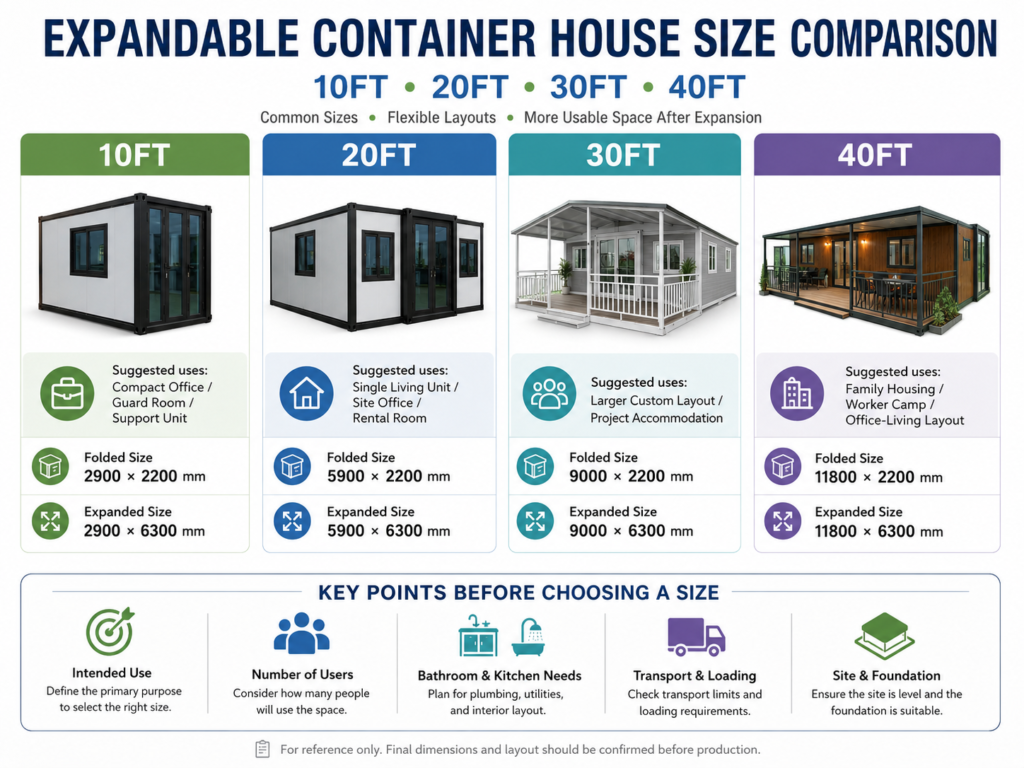
Sinopala’s common expandable container house sizes include:
- 10ft expandable container house
- 20ft expandable container house
- 30ft expandable container house
- 40ft expandable container house
Each size has different application value.
A small unit may be suitable for a compact office, guard room, or temporary support space.
A 20ft unit is often used for single living units, rental rooms, small site offices, or worker accommodation.
A 30ft unit may be used for larger custom layouts.
A 40ft unit is usually better when the buyer needs more bedrooms, a larger living area, bathroom, kitchen, or family-style layout.
The final dimensions may vary by model and configuration, so buyers should always confirm the official drawing before production.
As a practical shipping reference, Sinopala’s standard 20ft expandable container house can usually load 2 sets in one 40HQ container. A 30ft or 40ft expandable unit normally loads 1 set per 40HQ container. For compact models, a 20ft-700 expandable house can load about 6 sets per 40HQ, while a 10ft expandable house can load about 4 sets per 40HQ. Final loading quantity should always be confirmed according to the exact model, packing size and configuration.
10ft Expandable Container House
A 10ft expandable container house is usually suitable for compact use cases.
Possible applications include:
- guard room
- small office
- storage support room
- temporary rest area
- compact accommodation
- site support unit
This size is not usually chosen for full residential living because the interior space is limited compared with 20ft or 40ft units.
Buyers may consider a 10ft expandable unit when the project has limited site space, small user numbers, or simple functional needs.
Before choosing a 10ft unit, buyers should confirm:
- whether bathroom or toilet is needed
- whether the unit needs air-conditioning
- whether the interior layout is practical
- whether the site has enough unfolding space
- whether the unit will be used alone or with other units
20ft Expandable Container House
A 20ft expandable container house is one of the most popular options for overseas buyers.
It is commonly used for:
- single living unit
- small rental unit
- office-living unit
- site office
- temporary accommodation
- small worker housing unit
- farm or rural housing
- emergency support housing
A 20ft expandable unit can often support a basic living layout, depending on configuration.
Possible layout elements may include:
- bedroom area
- living area
- bathroom
- small kitchen or kitchenette
- storage
- office desk area
For many buyers, the 20ft size offers a practical balance between usable space, transport planning, and budget.
However, buyers should not assume every 20ft expandable house has the same layout. Bathroom position, kitchen position, door and window layout, furniture plan, and electrical/plumbing routes should all be confirmed before production.
For buyers comparing budget, wall panel thickness and project quotation, the expandable container house price guide explains the 20ft special-offer model, EXW pricing and cost factors in more detail.
30ft Expandable Container House
A 30ft expandable container house may be suitable for buyers who need more space than a 20ft unit but do not require a full 40ft layout.
Possible applications include:
- larger office-living unit
- customized accommodation
- small family-style housing
- project support room
- rental or tourism unit
- special layout requirement
This size may be useful when the buyer wants additional room for storage, larger bathroom, more comfortable living area, or a customized internal layout.
Because 30ft units are less standard than 20ft or 40ft units in many projects, buyers should pay more attention to:
- exact drawing
- packed size
- loading method
- shipping arrangement
- local truck transport
- installation site clearance
- foundation layout
- customization cost
40ft Expandable Container House
A 40ft expandable container house is usually selected when the buyer needs larger interior space.
It may be suitable for:
- family accommodation
- two-bedroom layout
- larger rental unit
- worker accommodation
- site office with meeting area
- camp housing
- remote project housing
- office-living combination
- tourism or guest accommodation
A 40ft expandable unit can provide more space for bedrooms, living area, bathroom, kitchen, storage, and office functions.
Compared with a 20ft unit, a 40ft unit may offer better layout flexibility, but it also requires more planning.
Buyers should confirm:
- site access
- unloading space
- crane or forklift availability
- foundation layout
- expanded width and clearance
- utility connection route
- bedroom and bathroom position
- kitchen layout
- local transport restrictions if applicable
A larger unit may look more attractive, but it is not always the best choice if the project site is narrow, remote, difficult to access, or lacks proper unloading equipment.
If you are comparing the two most common options, read our 20ft vs 40ft expandable container house comparison before choosing the final size.
Folded Size vs Expanded Size
For expandable container houses, folded size and expanded size must be checked separately.
The folded size affects:
- factory packing
- loading quantity
- container or truck transport
- shipping cost
- destination port handling
- inland delivery
- unloading equipment
The expanded size affects:
- usable interior area
- furniture arrangement
- bathroom and kitchen position
- door and window clearance
- foundation layout
- site spacing between units
- walking access
- maintenance space
- utility connection
For common 20ft expandable units, the expanded width may be around 6.2m depending on the model and design. However, this should be treated only as a general reference. The exact folded and expanded dimensions must be confirmed with the supplier’s drawing before ordering.
How Layout Changes by Size
Different sizes support different layouts.
A compact unit may be suitable for an office, guard room, or simple accommodation.
A 20ft expandable container house may support:
- studio layout
- one-bedroom layout
- small office layout
- office-living layout
- rental room layout
- worker accommodation layout
A 40ft expandable container house may support:
- larger one-bedroom layout
- two-bedroom layout
- family-style layout
- office with meeting area
- dormitory layout
- camp accommodation layout
- rental or tourism layout
For detailed layout planning, buyers can review expandable container house floor plans before confirming the final design.
This size guide focuses on choosing the right size. The floor plan article focuses more on internal layout arrangement, room division, bathroom/kitchen position, and design feasibility.
Bathroom and Kitchen Planning by Size
Bathroom and kitchen requirements can strongly affect the size decision.
If the buyer only needs an office or temporary sleeping unit, a simpler layout may be enough.
If the buyer needs a complete living unit, the size must allow enough space for:
- bathroom
- shower
- toilet
- sink
- kitchen cabinet
- countertop
- water inlet
- drainage outlet
- electrical sockets
- ventilation
- maintenance access
A 20ft unit can be suitable for a basic bathroom and kitchenette layout if planned carefully.
A 40ft unit gives more flexibility for larger bathroom, kitchen, living area, and bedroom separation.
Bathroom and kitchen positions should be confirmed before production because they affect plumbing, drainage, waterproofing, electrical routes, and installation work.
Choosing Size by Application
The right size depends on application.
- For site offices, buyers may choose 20ft or 40ft depending on how many people will use the office and whether a meeting area or restroom is needed.
- For worker accommodation, buyers should calculate the number of users, bed layout, storage, ventilation, bathroom and shower support, and site layout.
- For farm housing, buyers should consider distance from the city, water and power supply, local delivery, and whether the unit is for seasonal or long-term use.
- For rental or tourism use, buyers should consider comfort, bathroom layout, kitchen requirement, privacy, appearance, cleaning, maintenance, and local rental rules.
- For emergency or temporary housing, buyers should consider delivery speed, site access, unloading, foundation, water, electricity, drainage, and support facilities.
- For application planning, buyers can also review the article about uses of expandable container houses.
Size and Transportation
Size affects transport planning.
Before ordering, buyers should confirm:
- packed size
- gross weight if needed
- loading quantity
- packing method
- container type
- destination port
- local delivery route
- road access
- crane or forklift availability
- EXW or FOB quotation term
- whether a shipping agent is arranged
Expandable container houses are designed to provide more usable space after unfolding, but shipping still depends on the packed size, loading plan, destination port, and freight market.
For overseas buyers, the container house shipping guide should be reviewed before comparing quotations from different suppliers.
Sinopala currently mainly provides EXW and FOB quotations. Buyers or their shipping agents usually arrange ocean freight, customs clearance, destination port charges, local delivery, and site unloading depending on the trade term.
Size and Installation Site
A larger expanded size also means the site needs enough installation space.
Before choosing a size, buyers should check:
- whether trucks can reach the site
- whether the ground is level
- whether crane or forklift access is available
- whether there is enough space to unfold the unit
- whether nearby buildings, walls, trees, or power lines affect installation
- whether the foundation size matches the expanded layout
- whether water, electricity, and drainage can be connected
The full project is not only opening the unit. It may also include unloading, positioning, leveling, fixing, sealing checks, utility connection, inspection, and cleaning.
For site planning, buyers can review container house installation cost before confirming the total project budget.
Common Mistakes When Choosing Size
Many buyers choose the wrong size because they focus only on price or appearance.
Common mistakes include:
- choosing a unit that is too small for the number of users
- ignoring bathroom and kitchen space
- forgetting storage
- not checking the expanded width
- not leaving enough unfolding clearance
- not confirming door and window position
- not checking local transport access
- assuming 20ft and 40ft layouts are only length differences
- ignoring foundation and utility connection
- comparing prices without checking configuration
These mistakes can lead to higher local costs, layout problems, installation delays, or poor daily use.
What Buyers Should Confirm Before Ordering
Before confirming the final size, buyers should provide:
- intended use
- project country or destination port
- preferred size: 10ft, 20ft, 30ft, or 40ft
- estimated quantity
- number of users
- bedroom requirement
- bathroom, kitchen, office, toilet, or shower needs
- layout requirement
- wall panel and insulation requirement
- interior finish requirement
- expected project duration
- EXW or FOB trade term
- whether a shipping agent is arranged
- site access condition
- unloading equipment
- foundation and utility connection plan
With this information, the supplier can recommend a more suitable size instead of only giving a general price.
Conclusion
Expandable container house sizes should be selected based on project use, layout, number of users, bathroom and kitchen requirements, transportation, installation site, foundation, and utility connection.
Sinopala’s common expandable container house sizes include 10ft, 20ft, 30ft, and 40ft. A 20ft expandable container house is often suitable for single living units, small offices, rental rooms, and temporary accommodation. A 40ft expandable container house is usually better for larger living layouts, family accommodation, worker housing, camp use, and office-living combinations.
The safest way to choose the right size is to confirm the folded size, expanded size, layout drawing, configuration, shipping arrangement, and site installation conditions before ordering.
Need Help Choosing the Right Expandable Container House Size?
If you are not sure whether to choose a 10ft, 20ft, 30ft, or 40ft expandable container house, Sinopala can help review your project requirements before quotation.
To recommend a suitable size and layout, please share:
- intended use
- project country or destination port
- required size if known
- estimated quantity
- number of users
- layout requirements
- bathroom, kitchen, office, bedroom, toilet, or shower needs
- wall panel and insulation requirements
- preferred trade term: EXW or FOB
- whether you already have a shipping agent
- site access and unloading conditions
- foundation and utility connection plan
Contact Sinopala:
WhatsApp: +86 150 1103 0786
Email: Lee@sinopala.com
Website: www.sinopala.com