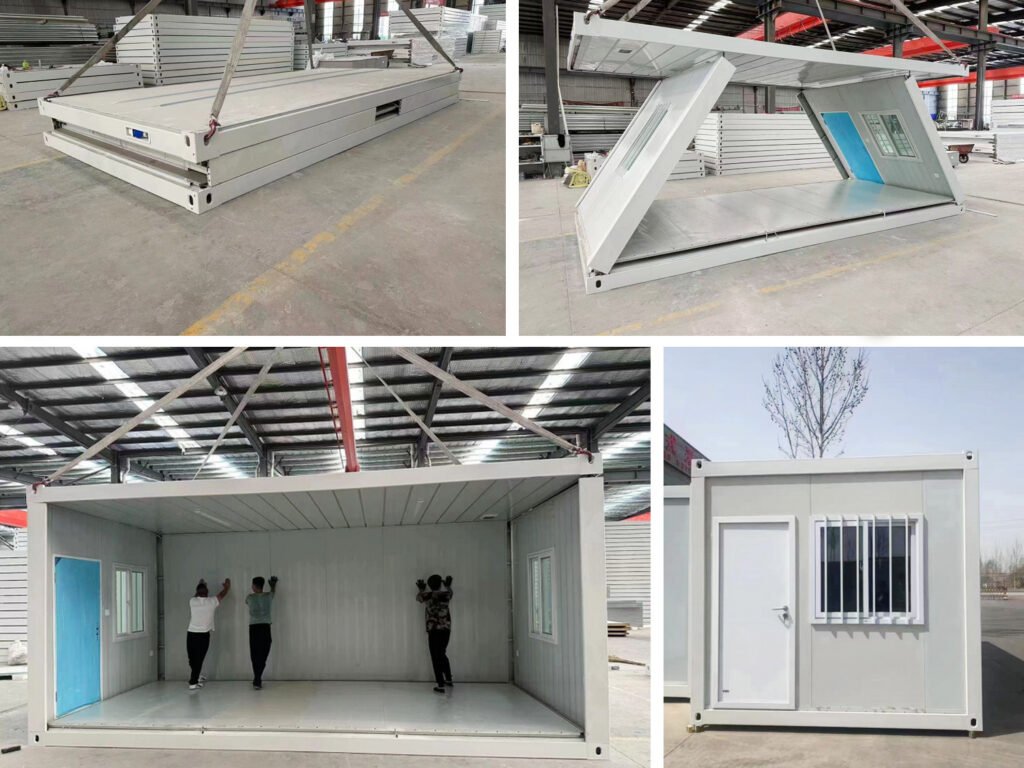
As global construction costs continue to rise and project timelines become increasingly compressed, modular building solutions are gaining attention across residential, commercial, and industrial sectors. Among these innovations, the folding house has emerged as a practical and scalable alternative to traditional construction.
But what exactly is a folding house, and why is it becoming an important part of modern modular housing?
This guide provides a comprehensive overview of folding house structure, advantages, applications, and long-term value.
What Is a Folding House?
A folding house is a prefabricated modular building designed to collapse into a compact unit for transportation and expand into a full-size functional structure on site. Unlike conventional buildings constructed entirely at the project location, folding houses are manufactured in factories and delivered ready for rapid deployment.
The defining feature of a folding house is its engineered hinge and frame system, which allows walls and roof sections to fold inward for transport and unfold securely during installation.
Once assembled, it functions like a standard building, complete with insulated walls, doors, windows, flooring, and optional electrical and plumbing systems.
Structural Components of a Folding House
Understanding how a folding house works requires examining its main structural elements:
1. Steel Frame System
Most folding houses use galvanized steel frames for structural strength and corrosion resistance. The frame ensures load-bearing stability during both transportation and long-term use.
2. Folding Mechanism
The hinged expansion design allows the structure to collapse into a transportable format and reopen efficiently on site. High-quality hinge systems are engineered for repeated deployment.
3. Insulated Wall Panels
Sandwich panels with thermal insulation materials help maintain indoor temperature control, making folding houses suitable for different climate conditions.
4. Integrated Utilities
Depending on configuration, electrical wiring, lighting fixtures, plumbing lines, and drainage systems can be pre-installed in the factory to reduce on-site labor.
Key Advantages of Folding Houses
Rapid Installation
One of the primary benefits of a folding house is installation speed. In many cases, a unit can be unfolded and secured within hours, significantly shortening project timelines.
Transportation Efficiency
Because the structure folds into a compact form, multiple units can be shipped together in a single container. This reduces freight costs and improves export efficiency.
Cost Control
Factory-based production lowers material waste and labor variability. Combined with reduced construction time, folding houses offer predictable budgeting for developers and contractors.
Flexibility and Scalability
Units can be used individually or combined to form larger complexes such as dormitories, offices, clinics, or temporary housing camps.
Common Applications of Folding Houses
Folding houses are used across a wide range of industries and project types:
- Construction site accommodation
- Remote workforce housing
- Emergency and disaster relief shelters
- Temporary offices
- Tourism and vacation cabins
- Infrastructure and mining projects
Their portability makes them particularly valuable in regions where rapid deployment is critical.
How Long Does a Folding House Last?
Durability depends on material quality, environmental conditions, and maintenance practices. With a galvanized steel structure and proper protective coatings, folding houses can serve for many years in both temporary and semi-permanent applications.
Insulation performance and weather resistance can be customized according to regional requirements.
Folding Houses vs Traditional Construction
Compared to conventional concrete or brick buildings, folding houses offer:
- Shorter construction cycles
- Lower labor dependency
- Reduced material waste
- Easier relocation options
However, they may require compliance checks based on local building regulations and zoning policies.
The Role of Folding Houses in Modern Modular Construction
The growing popularity of folding houses reflects a broader industry shift toward industrialized building systems. Standardized production, supply chain efficiency, and scalable deployment models are becoming increasingly important in global construction.
For developers, distributors, and project contractors, folding houses provide a balance between speed, cost efficiency, and structural reliability.
Conclusion
A folding house is more than a portable structure—it is a factory-engineered building solution designed to optimize transportation, installation time, and cost control.
As demand for flexible and modular construction increases worldwide, folding houses are expected to play a significant role in shaping the future of modern building systems.