Introduction
Expandable container houses and tiny houses are both compact building options, but they are designed for different needs.
A tiny house usually focuses on personal living, lifestyle design, mobility, or small residential use. An expandable container house is usually designed as a transportable modular unit that can provide more usable space after opening.
The better choice depends on your budget, space requirement, shipping plan, installation condition, local rules, and how the building will be used.
This guide compares expandable container houses and tiny houses by structure, space, transportation, installation, cost, regulations, and common use cases.
Expandable Container House vs Tiny House: Quick Comparison
| Factor | Expandable Container House | Tiny House |
|---|---|---|
| Main purpose | Modular space for housing, offices, camps or rental use | Compact personal living or lifestyle housing |
| Space | Expands after opening and usually offers more usable area | Smaller interior space with compact furniture |
| Transport | Shipped in compact form, often planned for export | Often local or regional transport, sometimes trailer-based |
| Installation | Needs site preparation, unloading, opening and utility connection | Needs parking/foundation, utilities and local approval |
| Cost | Depends on size, panels, layout, finish, quantity and shipping | Depends on design, trailer, finish, local labor and customization |
| Best use | Accommodation, site offices, rental units, remote housing | Personal living, vacation cabins, backyard units |
What Is an Expandable Container House?
An expandable container house is a modular building unit that can be transported in a compact form and expanded after arriving on site.
Depending on the model and configuration, it may include bedrooms, living space, bathroom, kitchen, windows, doors, wall panels, electrical routes, flooring, and interior fittings.
Expandable container houses are often considered for:
- temporary accommodation
- rental units
- site offices with living functions
- worker housing
- farm housing
- emergency housing
- remote project accommodation
- modular housing projects
- 20ft or 40ft layout solutions
The main advantage is that the unit can provide more usable interior space after opening compared with compact container units.
However, buyers should confirm the actual layout, unfolding direction, site clearance, foundation condition, bathroom position, wall panel requirement, and installation preparation before ordering.
For buyers comparing layouts, expandable container house floor plans should be reviewed carefully before confirming the final design.
What Is a Tiny House?
A tiny house is a small residential unit designed for compact living. It is often used by individual owners who want a smaller home, vacation cabin, backyard unit, or mobile lifestyle space.
Tiny houses are commonly designed around:
- personal living
- lifestyle appeal
- customized appearance
- compact furniture
- trailer-based mobility in some markets
- wood or light steel construction
- small-scale residential use
Tiny houses can be attractive and comfortable, but they are usually more personal-use oriented. They may not always be the best choice when a buyer needs repeatable units, export packing, multiple-room layouts, project accommodation, or larger quantity planning.
For overseas project buyers, tiny houses also require careful review of local regulations, road transport rules, trailer standards, utilities, and site installation requirements.
Main Difference: Personal Lifestyle vs Project Use
The biggest difference is the use logic.
A tiny house is usually designed for one owner or one family. The design often focuses on lifestyle, appearance, interior atmosphere, and personal preference.
An expandable container house is usually selected for project use. The buyer often cares about layout, quantity, delivery plan, installation, repeatability, maintenance, and whether the unit can support accommodation, office, bathroom, kitchen, or project living functions.
For example, a tiny house may be suitable for a private vacation cabin. But if a buyer needs 10, 20, or 50 accommodation units for a project site, an expandable container house may be easier to organize, quote, produce, pack, and install as a repeatable solution.
Structure and Production Method
Expandable container houses usually use a modular steel-frame structure with wall panels, roof, floor, doors, windows, and interior components prepared in the factory according to the order configuration.
Tiny houses may use wood, light steel, trailer frames, or mixed construction methods depending on the builder and country.
This difference matters because the production method affects:
- repeatability
- material confirmation
- packing method
- quality control
- installation guidance
- export documentation
- replacement and maintenance planning
A beautiful tiny house may work well as a single customized unit, but it may not be easy to repeat across many project sites. An expandable container house is usually more suitable when the buyer wants clearer product specifications, repeated layouts, and project-based purchasing.
Space and Layout Comparison
Expandable container houses can offer more usable interior space after unfolding. This makes them suitable for layouts that may include bedrooms, living area, bathroom, kitchen, office space, or storage.
Tiny houses are compact by design. They use loft beds, foldable furniture, built-in cabinets, and creative storage to maximize limited space.
For private use, tiny house design can be attractive. But for project accommodation, rental units, worker housing, or office-living layouts, buyers usually need to confirm whether the space is practical for daily use.
Important layout questions include:
- How many people will use one unit?
- Is a separate bedroom needed?
- Is a bathroom required?
- Is a kitchen or kitchenette required?
- Is there enough walking space?
- Are electrical outlets and lighting positions planned?
- Is ventilation suitable?
- Can furniture be installed without blocking doors or windows?
If the project requires more practical interior planning, a container house interior design plan should be confirmed before production.
Transportation and Export Planning
Transportation is one of the biggest differences for international buyers.
Tiny houses are often designed for local or regional movement, especially when they are built on trailers. Exporting them internationally may require special packing, road transport planning, customs review, and destination-side handling.
Expandable container houses are more commonly considered for overseas modular housing projects because suppliers can usually provide packing information, loading photos, packing list, and export documents according to the order.
Before ordering an expandable container house, buyers should confirm:
- product size
- packing dimensions
- loading plan
- destination port
- EXW or FOB trade term
- whether a shipping agent is arranged
- unloading method at destination
- crane or forklift availability
- site access condition
Buyers should review the container house shipping guide when comparing overseas delivery cost and responsibility.
Sinopala currently mainly provides EXW and FOB quotations. Under these terms, ocean freight, customs clearance, destination port charges, local delivery, and site unloading are usually arranged by the buyer or the buyer’s shipping agent.
Installation and Site Preparation
Expandable container houses are factory-prepared, but they still require site preparation.
Buyers should confirm:
- foundation condition
- site levelness
- truck access
- unloading space
- crane or forklift availability
- local labor
- electrical connection
- water supply
- drainage
- local contractor support if needed
Tiny houses may also require foundation, trailer parking, utility connection, anchoring, local approval, and road access depending on the design.
The key difference is that buyers often use expandable container houses as repeatable modular units, while tiny houses usually serve as individual customized homes.
For B2B projects, buyers should review installation planning together with product type, quantity, site condition, and local labor availability.
Cost and Budget Comparison
It is risky to say that one option is always cheaper than the other.
The total cost depends on size, material, layout, interior configuration, bathroom and kitchen requirements, shipping, local delivery, foundation, installation, and local approval.
Expandable container houses may be more practical for project-based purchasing when buyers need repeated units and clearer production specifications.
Tiny houses may become more expensive when the buyer requires customized design, high-end interior finishing, trailer systems, local labor, or special design features.
When comparing costs, buyers should not only compare the unit price. They should also compare:
- production scope
- included configuration
- bathroom and kitchen details
- insulation and wall panels
- packing and loading method
- shipping responsibility
- local delivery
- foundation
- utility connection
- installation labor
- long-term maintenance
For buyers comparing supplier quotations, the expandable container house price guide can help review cost factors before making a decision.
Local Regulations and Approval
Both expandable container houses and tiny houses may be affected by local laws.
Tiny houses may face rules related to trailer registration, road transport, zoning, permanent residence approval, minimum dwelling size, utility connection, and foundation requirements.
Expandable container houses may face rules related to temporary structures, modular buildings, building permits, fire safety, electrical standards, plumbing standards, wind requirements, and occupancy approval.
The supplier can provide drawings, specifications, product information, and export support, but local approval is usually handled by the buyer, local engineer, architect, contractor, or authority.
Before ordering either option, buyers should check local regulations first, especially when the unit will be used for living, rental, tourism, or long-term accommodation.
Which Is Better for Residential Use?
For private lifestyle living, a tiny house may be more attractive because it can be highly customized and designed around personal taste.
For project-based residential or accommodation use, an expandable container house may be more practical because it can provide repeatable layouts, clearer production control, and more usable space after unfolding.
Expandable container houses may be considered for:
- temporary living units
- rental accommodation
- site accommodation
- worker housing
- remote housing
- farm accommodation
- office-living units
But buyers should still confirm local rules before using them as residential buildings. Some regions may allow temporary accommodation but restrict permanent residential use.
Which Is Better for Commercial or Project Use?
For commercial and project use, expandable container houses usually have stronger practical value.
They are more suitable for:
- contractors
- project developers
- rental operators
- mining or construction projects
- temporary housing projects
- site office projects
- emergency accommodation
- modular project facilities
Tiny houses can work for tourism, short-stay rental, or boutique accommodation if local laws allow, but they are usually less suitable for large-scale repeatable project deployment.
For buyers who need multiple units, export packing, repeated layouts, and clearer installation planning, expandable container houses are often easier to manage.
Which Is Better for Mobility?
Both options can be movable, but their mobility is different.
Tiny houses are often associated with trailer-based movement. This may be useful for local road transport, but it depends on trailer standards, road laws, towing rules, size limits, and local registration requirements.
Expandable container houses are usually moved by truck, container transport, or lifting equipment. They are not designed to be towed like a trailer home. If the buyer plans to relocate the unit later, this should be confirmed before ordering.
Mobility should not be assumed. Buyers should check structure, lifting method, transport access, road restrictions, site condition, and whether repeated relocation is realistic.
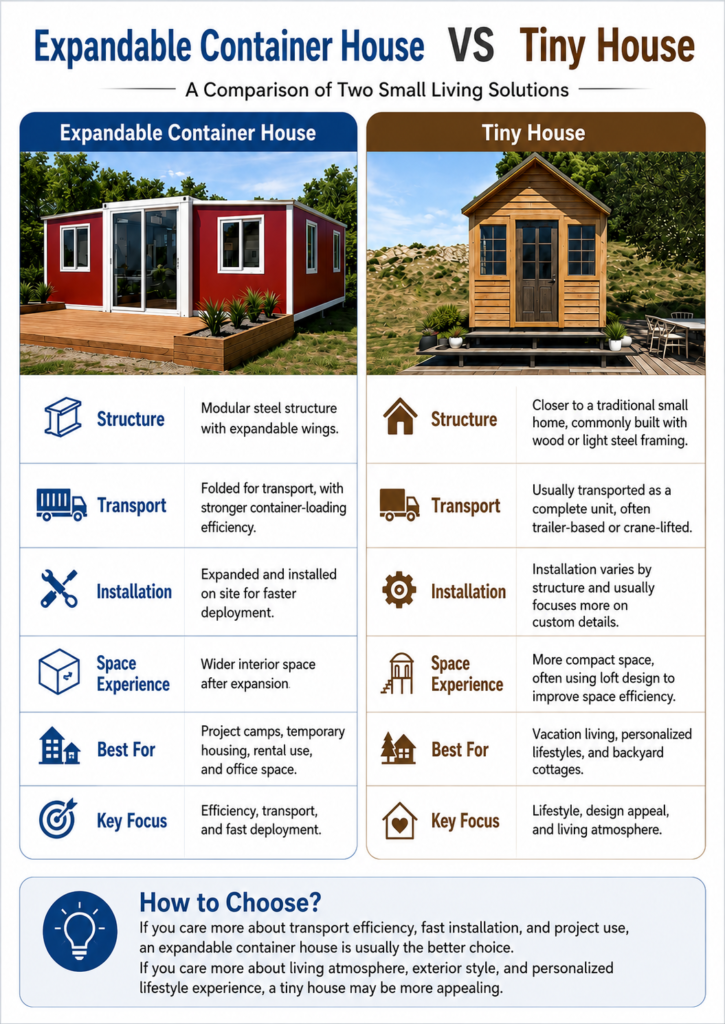
Comparison Summary
Here is a practical comparison:
| Item | Expandable Container House | Tiny House |
|---|---|---|
| Main use | Project accommodation, site office, rental units, temporary housing | Personal living, vacation home, lifestyle housing |
| Buyer type | Contractors, developers, project owners, rental operators | Individual buyers, private owners, lifestyle users |
| Space | More usable space after unfolding | Compact space with creative design |
| Transport | More suitable for export-based modular housing projects | Often better for local trailer-based movement |
| Installation | Needs foundation, unloading, utility connection, and site preparation | Needs foundation or trailer setup, utility connection, and local approval |
| Customization | Layout and configuration can be planned for project use | Often highly customized for personal design |
| Best for | Repeatable B2B projects and practical accommodation needs | Personal lifestyle and small-scale residential use |
This table should be used as a starting point. The final decision still depends on project use, quantity, site condition, shipping plan, and local approval.
Common Mistakes When Comparing Them
Many buyers compare expandable container houses and tiny houses only by appearance or social media photos.
Common mistakes include:
- choosing based on photos instead of project use
- ignoring local approval
- not checking road or transport rules
- comparing prices without checking included configuration
- forgetting bathroom and kitchen requirements
- not confirming insulation and wall panels
- ignoring foundation and utility connection
- assuming both options are equally mobile
- not checking export packing and shipping responsibility
- not confirming EXW or FOB terms
These are similar to the common mistakes when buying container houses from China. Buyers should confirm drawings, specifications, packing details, layout, trade terms, and installation conditions before placing an order.
Which One Should You Choose?
Choose an expandable container house if you need:
- more usable space after installation
- accommodation or office-living function
- project-based purchasing
- repeated layouts
- export packing support
- modular housing for temporary or semi-permanent use
- a solution for contractors, developers, rental operators, or project owners
Choose a tiny house if you need:
- a personal lifestyle home
- highly customized appearance
- local trailer-based mobility
- private vacation use
- a design-focused compact home
- small-scale individual living
Neither option is automatically better. The better choice depends on the buyer type and project purpose.
Conclusion
Expandable container houses and tiny houses both solve space and housing problems, but they are not designed for the same market.
Tiny houses are usually more personal, lifestyle-focused, and design-driven. Expandable container houses are usually more practical for project-based accommodation, site offices, rental units, temporary housing, and overseas modular housing procurement.
For B2B buyers, the expandable container house is often easier to evaluate through layout, specifications, packing, shipping, installation, and project use.
The best decision should be based on intended use, quantity, layout, destination port, local approval, site access, utility connection, and long-term operation requirements.
Need Help Comparing Expandable Container Houses?
If you are comparing expandable container houses with tiny houses or other modular housing options, Sinopala can help review your project requirements before quotation.
To recommend a suitable option, please share:
- intended use
- project country or destination port
- required size: 20ft or 40ft, or other size requirement
- estimated quantity
- layout requirements
- bathroom, kitchen, office, bedroom, toilet, or shower needs
- expected project duration
- preferred trade term: EXW or FOB
- whether you already have a shipping agent
- site access and unloading conditions
Contact Sinopala:
WhatsApp: +86 150 1103 0786
Email: info@sinopala.com
Website: www.sinopala.com