Introduction
Folding container houses are widely used for worker accommodation, site offices, student dormitories, temporary project housing, modular camps, farm support rooms, and emergency housing.
One of the first questions many overseas buyers ask is: how much does a folding container house cost?
The answer depends on size, structure, wall panel type, interior configuration, bathroom or kitchen requirements, electrical system, order quantity, packing method, loading plan, destination port, and EXW or FOB trade term.
A basic folding container house may look simple from the outside, but two units with similar photos can have very different prices if the steel frame, wall panels, insulation, bathroom, accessories, and packing details are different.
This guide explains folding container house price factors from a practical purchasing point of view.
Average Folding Container House Price in 2026
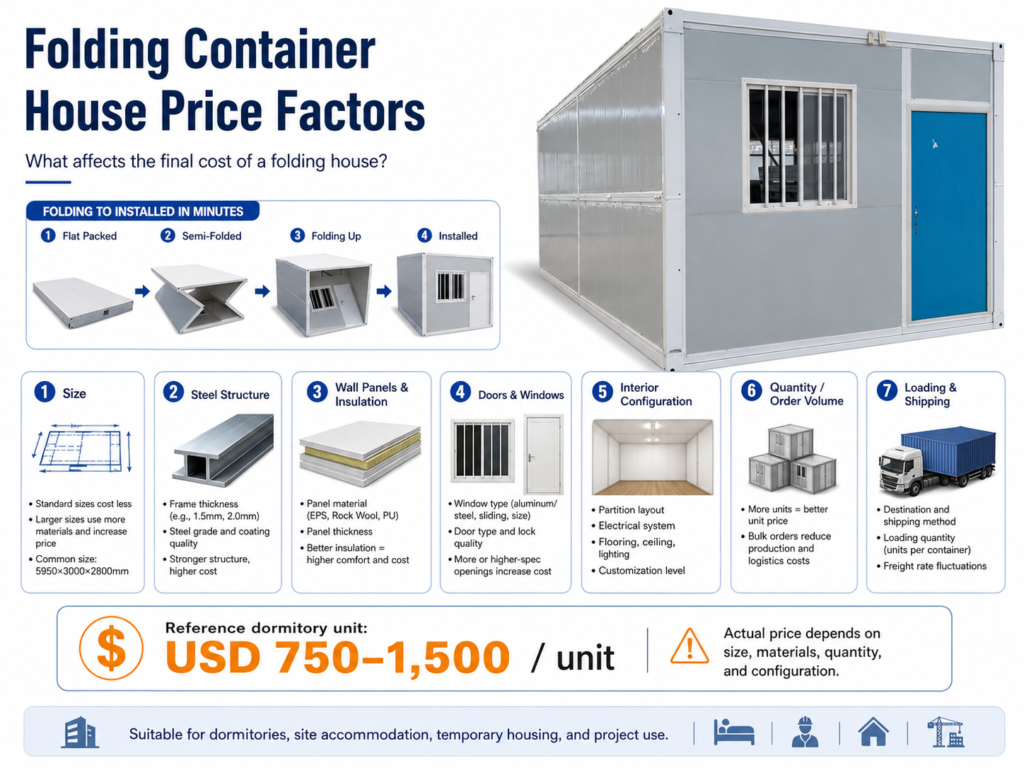
There is no single fixed price for a folding container house.
As a general factory price reference, folding container houses may fall roughly in these ranges depending on configuration:
- basic dormitory or simple accommodation configuration: around USD 750–1,500 per unit
- standard site office or worker accommodation configuration: around USD 1,500–3,500 per unit
- upgraded units with bathroom, shower, kitchen, better wall panels, furniture, or special requirements: USD 3,500–6,000+ per unit
These are reference factory price ranges only, not fixed final project prices.
The final quotation depends on:
- product size
- steel frame configuration
- wall panel type
- insulation requirement
- roof and floor system
- doors and windows
- bathroom or shower requirement
- kitchen requirement
- electrical and plumbing system
- furniture or interior finish
- order quantity
- packing method
- loading quantity
- EXW or FOB quotation term
Buyers should also remember that ocean freight, customs clearance, destination port charges, local delivery, foundation, unloading, installation labor, utility connection, and local approval are usually not included in a simple unit price.
What Is Usually Included in the Unit Price?
A standard folding container house quotation may include the factory-produced main unit and basic configuration.
Depending on the model and supplier, this may include:
- steel frame
- roof and floor system
- wall panels
- doors and windows
- folding structure
- basic electrical routes
- standard accessories
- packing for shipment
However, buyers should not assume every quotation includes the same items.
Some quotations may exclude:
- toilet
- shower
- bathroom waterproofing upgrades
- kitchen cabinets
- furniture
- air-conditioning
- water heater
- upgraded wall panels
- special electrical standards
- plumbing and drainage preparation
- spare parts
- installation tools
- loading photos
- ocean freight
- local delivery
- foundation
- site installation
Before comparing prices, buyers should check the configuration line by line.
Factor 1: Size and Layout
Size and layout are major price factors.
A simple single-room folding container house is usually more economical than a unit with bathroom, shower, kitchen, partitions, or more complex interior functions.
Common layout options may include:
- open accommodation unit
- site office
- worker dormitory
- storage support room
- toilet or shower unit
- office-living unit
- project camp unit
Buyers should choose the size and layout based on the number of users, intended use, site condition, and whether the unit needs bathroom, kitchen, office, or sleeping functions.
For buyers still comparing product types, the article about what a folding house is can help clarify the basic structure before comparing prices.
Factor 2: Steel Frame and Structural Configuration
The steel frame is one of the core cost factors in a folding container house.
Price may vary depending on:
- frame design
- steel specification
- welding quality
- roof and floor structure
- hinge and folding mechanism
- connection parts
- anti-rust treatment
- reinforcement requirement if applicable
A lower price may mean a lighter frame, fewer accessories, simpler anti-rust treatment, or weaker structural details.
Buyers should not compare only exterior photos. They should ask for material details, drawings, or structural descriptions before placing an order.
For buyers who want to understand the product structure in more detail, the folding container house structure guide can be reviewed before confirming the quotation.
Factor 3: Wall Panel Type and Insulation
Wall panels affect price, comfort, safety, and long-term use.
Common wall panel options may include:
- EPS sandwich panels
- rock wool sandwich panels
- PU or other insulated panels
- customized wall panel systems depending on project requirements
Different projects may need different panel choices.
Buyers should confirm:
- wall panel type
- panel thickness
- insulation material
- fire-resistance requirement if applicable
- moisture resistance
- roof insulation
- bathroom wall protection if included
- interior finish
A unit used in hot, cold, humid, coastal, or high-wind environments may need different material choices from a short-term temporary site office.
Higher-performance panels may increase the unit price, but they may improve comfort, safety, and durability depending on the project.
Factor 4: Bathroom, Shower, and Kitchen Requirements
Bathroom, shower, and kitchen requirements can significantly increase the final price.
A basic accommodation unit without bathroom or kitchen is usually simpler and cheaper.
A complete living unit may require:
- toilet
- shower
- sink
- waterproof flooring
- bathroom wall protection
- ventilation
- water inlet
- drainage outlet
- plumbing system
- kitchen cabinet
- countertop
- electrical sockets
- appliance space
These areas affect structure, waterproofing, plumbing, drainage, electrical routing, production time, and installation planning.
Buyers should confirm bathroom and kitchen requirements before production. Adding them later can increase cost and delay the project.
Factor 5: Electrical and Plumbing Configuration
Electrical and plumbing requirements also affect the price.
Buyers should confirm:
- voltage standard
- socket quantity and location
- lighting position
- switch position
- air-conditioning preparation
- circuit protection requirement if needed
- water inlet
- drainage outlet
- toilet and shower connection
- kitchen sink connection
- local utility connection responsibility
For overseas projects, the factory can prepare certain routes or reserved points based on the order, but final electrical and plumbing connection usually depends on the buyer’s local team or qualified local contractors.
Buyers should not assume the unit is fully ready for local use without checking local electrical and plumbing requirements.
Factor 6: Order Quantity
Order quantity can affect the average unit cost.
A single unit usually has a higher average cost because communication, drawing confirmation, packing, and logistics coordination are spread across only one unit.
For larger orders, average pricing may be better depending on:
- quantity
- standardization level
- repeated layout
- production schedule
- packing method
- loading plan
- customization level
- delivery schedule
However, larger orders also require better planning.
Before placing a batch order, buyers should confirm site layout, unloading space, foundation, utility connection, drainage, installation labor, and project schedule.
Factor 7: Packing, Loading, and Shipping
Shipping is an important part of the total project cost.
Folding container houses are designed for compact transport, and multiple units may be loaded together depending on size, packing method, and container type.
However, buyers should not assume every supplier has the same loading quantity or freight cost.
Before ordering, buyers should ask for:
- folded size
- packing dimensions
- loading quantity
- packing list
- loading photos
- gross weight if needed
- container type
- destination port
- EXW or FOB trade term
- whether a shipping agent is arranged
For overseas buyers, the container house shipping guide should be reviewed before comparing quotations because packing and loading can affect the real delivered cost.
Sinopala currently mainly provides EXW and FOB quotations.
Under EXW terms, the buyer or buyer’s agent usually arranges pickup from the factory and handles export, ocean freight, customs clearance, destination port charges, local delivery, and site unloading.
Under FOB terms, the supplier usually delivers the goods to the agreed port in China according to the FOB arrangement. The buyer or buyer’s shipping agent usually handles ocean freight, destination port charges, customs clearance, local delivery, and site unloading.
Factor 8: Installation and Site Preparation
A low unit price does not mean the full project cost is low.
Buyers also need to consider local installation and site preparation, including:
- foundation
- ground leveling
- unloading equipment
- crane or forklift
- local labor
- tools
- sealing checks
- electrical connection
- water supply
- drainage or sewage connection
- inspection and cleaning
A standard folding container house may be opened and basically positioned within a few hours when the foundation is ready, unloading equipment is available, local workers understand the process, and tools are prepared.
However, full project readiness may take longer when the unit includes bathroom, kitchen, utility connection, multiple units, drainage work, site preparation, or local approval.
For site cost planning, buyers can review container house installation cost before confirming the total budget.
Does a Cheap Folding Container House Mean Better Value?
Not always.
A cheaper quotation may exclude important items or use simpler materials.
Buyers should check whether the quotation includes:
- correct size
- steel frame specification
- wall panel type
- roof and floor system
- doors and windows
- electrical system
- bathroom or shower if required
- kitchen if required
- plumbing and drainage
- accessories
- packing information
- loading information
- installation guidance
- EXW or FOB term
If these details are unclear, the buyer may face extra costs later for missing configuration, local modification, shipping, unloading, installation, or utility connection.
Many of these problems are similar to common mistakes when buying container houses from China.
Folding Container House vs Expandable Container House Price
Some buyers compare folding container houses with expandable container houses.
The two products have different structures, layout logic, transport methods, and use cases.
A folding container house is often selected for compact transport, temporary accommodation, site offices, dormitories, and project support units.
An expandable container house is often selected when the buyer needs more usable interior space after unfolding, especially for living units, rental rooms, office-living layouts, or larger accommodation layouts.
The cheaper option depends on the required configuration, quantity, destination port, installation site, and project purpose.
For product comparison, buyers can review expandable container house vs folding house before choosing a model.
Total Project Cost vs Unit Price
For B2B buyers, the unit price is only one part of the total cost.
The full project budget may include:
- unit price
- customization cost
- packing and loading
- ocean freight
- customs clearance
- destination port charges
- local delivery
- foundation
- unloading equipment
- installation labor
- electrical connection
- plumbing and drainage
- maintenance
- spare parts
This is why two suppliers may offer very different prices for what looks like the same product.
Buyers should compare the full configuration and responsibility scope, not only the lowest unit price.
What Information Is Needed for an Accurate Quote?
To prepare a more accurate quotation, buyers should provide:
- intended use
- project country or destination port
- required size
- estimated quantity
- number of users
- layout requirement
- whether toilet, shower, kitchen, office, or bedroom is needed
- wall panel and insulation requirement
- electrical and plumbing requirement
- interior finish requirement
- preferred trade term: EXW or FOB
- whether a shipping agent is arranged
- site access and unloading conditions
- foundation and utility connection plan
Without this information, the supplier can only provide a rough reference price, not a reliable project quotation.
Conclusion
Folding container house cost in 2026 depends on size, structure, wall panel type, bathroom or shower requirements, kitchen needs, electrical and plumbing systems, interior finish, quantity, packing method, loading plan, shipping arrangement, and EXW or FOB trade term.
A basic unit may have a lower factory price, but overseas buyers should compare the full configuration and total project cost.
The safest way to compare folding container house prices is to confirm drawings, specifications, included items, packing, loading, trade term, and local site requirements before ordering.
Need a Folding Container House Price Quote?
If you are planning a folding container house project, Sinopala can help review your requirements before quotation.
To prepare a more accurate price, please share:
- intended use
- project country or destination port
- required size
- estimated quantity
- number of users
- layout requirements
- toilet, shower, kitchen, office, bedroom, or basic accommodation needs
- wall panel and insulation requirements
- electrical and plumbing requirements
- preferred trade term: EXW or FOB
- whether you already have a shipping agent
- site access and unloading conditions
- foundation and utility connection plan
Contact Sinopala:
WhatsApp: +86 150 1103 0786
Email: info@sinopala.com
Website: www.sinopala.com