Introduction
Sinopala’s fixed-configuration 20ft expandable container house is offered at USD 4,800 EXW with 50mm wall panels or USD 5,800 EXW with 75mm wall panels. Both versions have two bedrooms, one living room, one kitchen and one bathroom. These are factory prices for the specified configurations, not delivered-and-installed prices.
Custom layouts, other sizes and different materials are quoted separately. The sections below explain what changes the price and which transport and site costs to allow for before comparing quotations.
20ft Expandable Container House: Two Fixed-Configuration Offers
| Model | Wall Panels | Included Layout | Reference Price |
|---|---|---|---|
| 20ft fixed-configuration offer | 50mm | 2 bedrooms, 1 living room, 1 kitchen and 1 bathroom | USD 4,800 EXW |
| 20ft fixed-configuration offer | 75mm | 2 bedrooms, 1 living room, 1 kitchen and 1 bathroom | USD 5,800 EXW |
For these two offers, wall panel colours can be selected from white, black, grey or wood grain. All other configuration details are fixed. Different room layouts, doors, windows, cabinets or finishes require a separately quoted custom model.
EXW pricing excludes ocean freight, destination charges, customs duties and taxes, local delivery, foundations, unloading, installation and utility connections. Confirm the current quotation and its included items before ordering.
For models that support customization, see our expandable container house options, including floor plans, wall panels, finishes, kitchens and bathrooms.
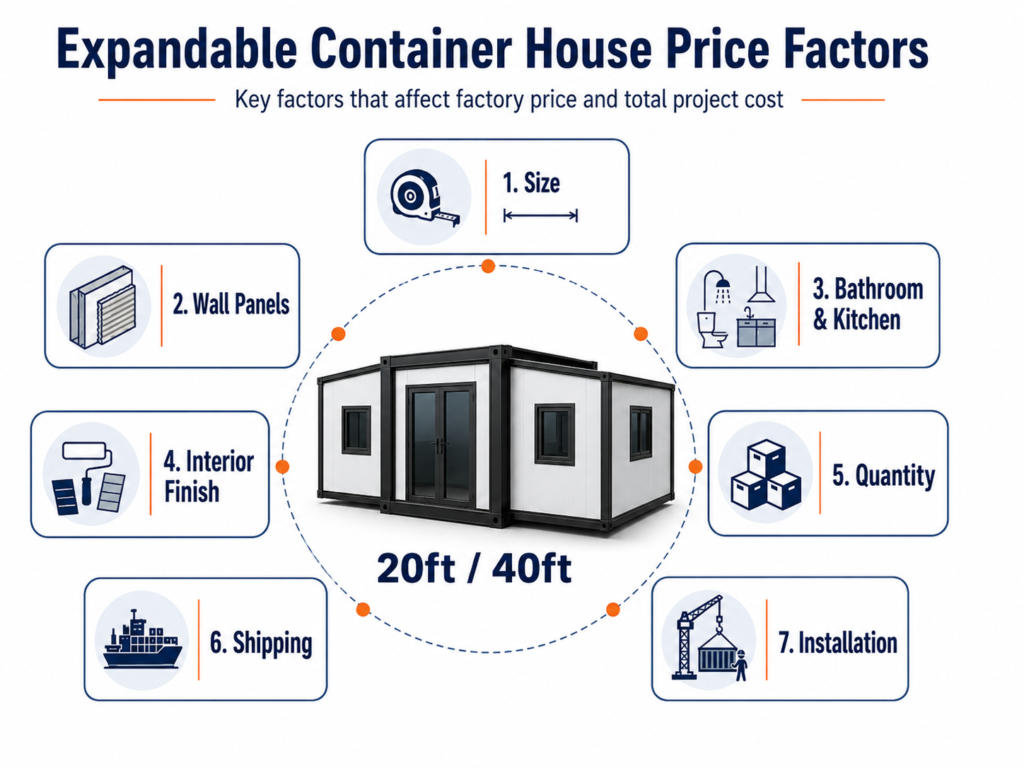
The final quotation depends on:
- size: 20ft, 40ft, or other available size
- wall panel type and thickness
- steel frame configuration
- bathroom and kitchen requirements
- electrical and plumbing system
- doors and windows
- interior finish
- furniture or appliance options
- quantity
- packing method
- EXW or FOB quotation term
Buyers should also remember that shipping, customs clearance, destination port charges, local delivery, foundation, unloading, installation, and utility connection are usually not included in a simple unit price.
What Is Usually Included in the Unit Price?
A basic expandable container house quotation may include the main factory-produced structure and standard configuration.
Depending on the model and supplier, this may include:
- steel frame
- roof and floor system
- wall panels
- doors and windows
- basic electrical routes
- basic interior panels
- folding or expanding structure
- packing for shipment
However, buyers should not assume every quotation includes the same items.
Some quotations may exclude:
- bathroom
- kitchen cabinets
- furniture
- air-conditioning
- water heater
- upgraded wall panels
- special electrical standards
- plumbing and drainage preparation
- loading photos
- installation accessories
- ocean freight
- local delivery
- foundation
- site installation
Before comparing prices, buyers should check the configuration line by line.
Factor 1: Size and Layout
Size is one of the biggest price factors.
A 20ft expandable container house is usually more economical than a 40ft unit because it uses less material and has a smaller layout scope.
A 40ft expandable container house usually costs more, but it can provide more usable space for bedrooms, living area, bathroom, kitchen, storage, and office-living layouts.
Common layout options include:
- open studio layout
- one-bedroom layout
- two-bedroom layout
- office layout
- rental accommodation layout
- dormitory-style layout
- customized project layout
Buyers should not choose the size only by unit price. A cheaper unit may not be suitable if the layout is too small for the number of users or required functions.
For layout planning, buyers can review the expandable container house floor plans before confirming the final quotation.
Factor 2: Wall Panels and Insulation
Wall panels and insulation affect both price and long-term use.
Different projects may require different wall panel configurations depending on climate, use duration, comfort requirements, and local expectations.
Buyers should confirm:
- wall panel type
- panel thickness
- insulation material
- fire-resistance requirement if applicable
- moisture resistance
- interior panel finish
- roof insulation
- bathroom wall protection if included
A unit used in a hot, cold, humid, coastal, or high-wind environment may need different material choices from a short-term temporary site office.
Higher-quality panels and better insulation may increase the unit price, but they can improve comfort, durability, and daily use.
Factor 3: Steel Frame and Structural Configuration
The steel frame is one of the core parts of an expandable container house.
Price may vary depending on:
- frame design
- steel specification
- welding quality
- anti-rust treatment
- connection parts
- roof and floor structure
- folding or expanding mechanism
- reinforcement requirements if applicable
Buyers should avoid comparing prices only by photos. Two expandable container houses may look similar from the outside but have different frame quality, material thickness, roof structure, connection parts, and anti-rust treatment.
For buyers concerned about safety and durability, the article on whether container houses are safe can help review structural and material factors before ordering.
Factor 4: Bathroom and Kitchen Configuration
Bathroom and kitchen configuration can significantly affect the final price.
A unit without bathroom or kitchen is usually simpler and cheaper. A complete living unit with bathroom, shower, toilet, sink, kitchen cabinets, countertop, plumbing, drainage, and electrical preparation will cost more.
For bathroom configuration, buyers should confirm:
- toilet position
- shower position
- drainage outlet
- water inlet
- waterproof flooring
- wall panel protection
- ventilation
- hot water preparation
- maintenance access
For kitchen configuration, buyers should confirm:
- sink position
- cabinet layout
- countertop length
- electrical socket position
- water inlet and drainage
- ventilation or exhaust
- appliance space
- wall protection behind cooking area
Bathroom and kitchen areas are technical parts of the unit. They should be confirmed before production because they affect structure, plumbing, drainage, waterproofing, electrical work, and installation.
Factor 5: Interior Finish and Furniture
Interior finish and furniture can change the price quickly.
Some buyers only need a basic shell or simple office unit. Others need a more complete living layout with bedroom, sofa, cabinets, bathroom, kitchen, lighting, flooring, and storage.
Interior options may include:
- wall and ceiling finish
- flooring
- cabinets
- wardrobes
- bed or bunk bed
- sofa
- table
- lighting
- sockets
- curtains or blinds
- bathroom fixtures
- kitchen cabinets
For rental, accommodation, or long-term living use, buyers should review the container house interior design plan before confirming the final price.
A beautiful rendering is not enough. The design should be practical to produce, ship, unfold, install, clean, maintain, and use.
Factor 6: Electrical and Plumbing Requirements
Electrical and plumbing requirements affect both price and installation planning.
Before quotation, buyers should confirm:
- voltage and electrical standard
- socket locations
- lighting positions
- air-conditioning preparation
- circuit protection requirements if needed
- bathroom wiring safety
- water inlet
- drainage outlet
- kitchen sink connection
- toilet and shower connection
- local utility connection responsibility
For overseas projects, local electrical and plumbing work may need to be completed by qualified local contractors according to local regulations.
The factory can prepare routes or basic systems based on the order, but final connection and approval usually depend on the buyer’s local site team.
Factor 7: Quantity and Order Scale
Quantity affects price because production, packing, loading, and shipping can be planned more efficiently when the buyer orders multiple units.
A single unit usually has a higher average cost because fixed work such as communication, drawing confirmation, packing, and logistics coordination is spread across only one unit.
For larger orders, buyers may get better average pricing depending on:
- quantity
- layout repetition
- standardization level
- production schedule
- packing method
- loading plan
- shipping route
- customization level
However, larger orders also need better planning. The buyer should confirm the site layout, unloading plan, foundation, utilities, drainage, and installation resources before shipping.
Factor 8: Packing, Loading, and Shipping
Shipping is a major part of the total project budget.
Expandable container houses are designed for compact transport compared with their opened size, but shipping cost still depends on product size, packing method, loading quantity, destination port, shipping route, and market freight rates.
Before ordering, buyers should ask for:
- packing dimensions
- loading quantity
- packing list
- loading photos
- gross weight if needed
- destination port
- EXW or FOB quotation term
- whether a shipping agent is arranged
The container house shipping guide should be reviewed before comparing quotations because different packing methods and loading plans can affect total delivery cost.
Sinopala currently mainly provides EXW and FOB quotations.
Under EXW terms, the buyer or buyer’s agent usually arranges pickup from the factory and handles export, shipping, customs clearance, destination port charges, local delivery, and site unloading.
Under FOB terms, the supplier usually delivers the goods to the agreed port in China according to the FOB arrangement, while the buyer or buyer’s shipping agent usually handles ocean freight, destination port charges, customs clearance, local delivery, and site unloading.
Factor 9: Installation and Site Preparation
A low unit price does not mean the total project cost is low.
Buyers also need to consider site preparation and installation, including:
- foundation
- ground leveling
- drainage
- truck access
- unloading space
- crane or forklift
- local labor
- tools
- electrical connection
- water supply
- sewage or drainage connection
- inspection and cleaning
As a general reference, a standard expandable container house may be opened and basically positioned within around 2–4 hours when the foundation is ready, unloading equipment is available, and workers are familiar with the installation steps.
However, the full project may take longer when the unit includes bathroom, kitchen, utility connection, multiple units, poor site access, or local approval requirements.
Buyers should review container house installation cost before confirming the project budget.
Factor 10: Customization Requirements
Customization can increase the final price and production time.
Common customization items include:
- special floor plans
- extra bedrooms
- larger bathroom
- kitchen upgrades
- door and window changes
- wall panel upgrades
- interior color changes
- furniture
- electrical standard adjustments
- plumbing changes
- exterior appearance requirements
Customization is useful when the buyer has a clear project need, but unnecessary customization can increase cost, delay production, and make maintenance more difficult.
Before customizing, buyers should confirm whether the change is truly needed for the project.
Does a Cheap Expandable Container House Mean Better Value?
Not always.
A lower price may look attractive at first, but it may exclude important items or use lower-grade materials.
Buyers should check whether the quotation includes:
- correct size
- frame structure
- wall panel type
- roof and floor system
- bathroom
- kitchen
- electrical system
- plumbing
- doors and windows
- interior finish
- packing
- loading information
- installation guidance
- EXW or FOB term
If the quotation is unclear, the buyer may face extra cost later for missing configuration, shipping, local delivery, foundation, installation, or utility connection.
Many of these problems are similar to the common mistakes when buying container houses from China.
Total Project Cost vs Unit Price
For B2B buyers, the unit price is only one part of the total project cost.
The full project budget may include:
- unit price
- customization cost
- packing and loading
- ocean freight
- customs clearance
- destination port charges
- local delivery
- site preparation
- foundation
- unloading equipment
- installation labor
- electrical connection
- plumbing and drainage
- maintenance
This is why two suppliers may give different prices for what appears to be the same product.
The buyer should compare the full configuration and responsibility scope, not only the lowest unit price.
Applications That Affect Price
Different applications require different configurations.
Expandable container houses can be used for:
- temporary accommodation
- rental units
- site offices
- worker housing
- farm housing
- remote project accommodation
- emergency support housing
- office-living units
- modular housing projects
A site office may not need the same configuration as a rental living unit. A worker dormitory may need a different layout from a family-style accommodation unit. A project in a humid coastal region may need different anti-rust and sealing attention from a dry inland project.
Application should always be confirmed before price comparison.
What Information Is Needed for an Accurate Quotation?
To prepare a more accurate quotation, buyers should provide:
- intended use
- project country or destination port
- required size: 20ft, 40ft, or other available size
- estimated quantity
- number of users
- preferred layout
- bathroom, kitchen, office, bedroom, toilet, or shower needs
- wall panel and insulation requirements
- electrical and plumbing requirements
- interior finish requirement
- preferred trade term: EXW or FOB
- whether a shipping agent is arranged
- site access and unloading conditions
Without this information, the supplier can only provide a rough price, not a reliable project quotation.
Conclusion
For a fixed 20ft layout with two bedrooms, one living room, one kitchen and one bathroom, Sinopala’s reference offers are USD 4,800 EXW with 50mm wall panels and USD 5,800 EXW with 75mm wall panels. Other sizes and customized configurations require a separate quotation.
Before comparing quotations, check the included materials, room layout and trade terms. Add shipping, destination charges, foundations, unloading, installation and utility connections to estimate the cost of putting the house into use.
Need an Expandable Container House Price Quote?
If you need a price for an expandable container house project, Sinopala can help review your requirements before quotation.
To prepare a more accurate price, please share:
- intended use
- project country or destination port
- required size: 20ft, 40ft, or other available size
- estimated quantity
- number of users
- layout requirements
- bathroom, kitchen, office, bedroom, toilet, or shower needs
- wall panel and insulation requirements
- interior finish requirements
- preferred trade term: EXW or FOB
- whether you already have a shipping agent
- site access and unloading conditions
Contact Sinopala:
WhatsApp: +86 150 1103 0786
Email: Lee@sinopala.com
Website: www.sinopala.com