Introduction
Modern modular living is not only about private homes. In many B2B projects, buyers need fast, practical, and repeatable space for workers, offices, dormitories, farms, camps, emergency support, and temporary project facilities.
Folding container houses are one option for these needs.
A folding container house is factory-produced, folded for compact transportation, delivered to the project location, and unfolded on site under prepared conditions. When the structure, configuration, shipping plan, and site preparation are properly matched, it can provide usable accommodation or working space for many project-based scenarios.
This article explains how folding container houses can support modern modular living and project accommodation from a practical buyer’s point of view.
What Is a Folding Container House?
A folding container house is a prefabricated modular unit designed to be transported in a compact folded form and opened on site.
Depending on the model and configuration, it may include:
- steel frame
- wall panels
- roof and floor system
- folding or hinge connections
- doors and windows
- locking or fixing parts
- optional electrical preparation
- optional plumbing preparation
- optional bathroom, shower, kitchen, or interior layout
After unfolding and fixing, the unit can be used as a living space, office, dormitory, support room, or temporary project building.
For buyers who want a basic explanation first, the article about what a folding house is can help clarify the product concept before comparing models.
Why Folding Container Houses Fit Modern Modular Living
Modern modular living usually requires more than a single building.
Many projects need:
- repeatable units
- faster site setup
- controlled production
- transport planning
- flexible layout
- temporary or semi-permanent use
- practical accommodation for different user groups
- easier batch deployment
Folding container houses match this demand because they are designed around factory production, compact transport, and on-site unfolding.
They are especially useful when the buyer needs functional space quickly under prepared site conditions, but does not want to build everything from zero at the project location.
Practical Living and Working Scenarios
Folding container houses can be used in many project-based scenarios.
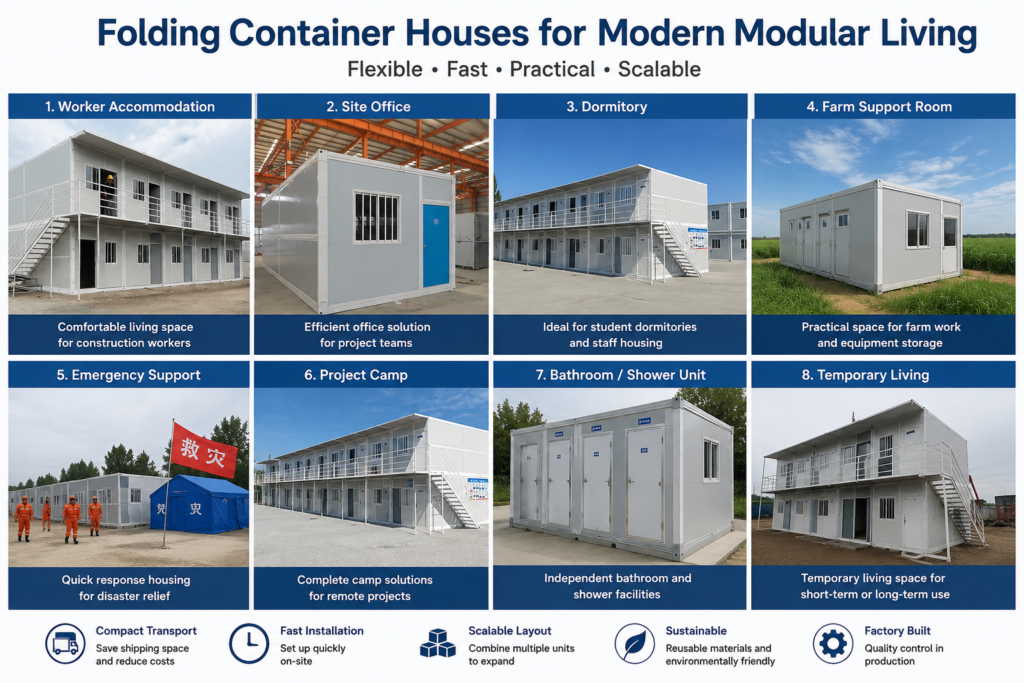
Common examples include:
- worker accommodation
- site offices
- student dormitories
- temporary staff housing
- farm support rooms
- emergency support units
- construction camp buildings
- remote workforce housing
- bathroom or shower support units
- temporary commercial or utility rooms
Different uses require different configurations.
A site office may need open working space, lighting, sockets, air-conditioning preparation, and basic furniture space.
A worker dormitory may need repeated room layout, durable floor use, ventilation, suitable wall panels, stronger doors and locks, and easy cleaning.
A bathroom or shower unit may need waterproof floor treatment, drainage, plumbing routes, ventilation, and maintenance access.
A camp project may need accommodation units, office units, toilet/shower units, kitchen or dining support, and a clear site layout.
Faster Setup Under Prepared Conditions
One reason folding container houses are used in modular projects is that part of the construction work is completed in the factory before delivery.
However, buyers should understand this correctly.
A folding container house can reduce part of the on-site construction work, but the project still needs:
- foundation preparation
- unloading equipment
- local workers
- tools
- enough site space
- installation sequence
- utility connection
- drainage planning
- final inspection
- local approval if required
A basic unit may be opened quickly when the foundation and equipment are ready.
But complete project readiness depends on site conditions, number of units, bathroom or kitchen requirements, electrical/plumbing connection, and local labor arrangement.
For detailed setup planning, buyers can review folding container house installation before arranging the site team.
Compact Transport and Project Planning
Folding container houses are designed to reduce transport volume compared with fully opened structures.
This can help batch shipment, but actual loading quantity depends on:
- folded size
- product weight
- packing method
- container type
- accessories
- protection requirements
- loading plan
- destination port
- EXW or FOB trade term
Buyers should not assume every folding container house has the same loading quantity or shipping cost.
Before ordering, confirm packing dimensions, loading method, loading quantity, packing list, and loading photos where possible.
For Sinopala’s folding container houses, the units are usually loaded in a folded compact form, and the exact loading method should be confirmed according to the final product model and container loading plan.
For export planning, buyers can review the container house shipping guide before comparing total project cost.
Flexible Layout for Different Project Needs
Folding container houses can be arranged individually or combined with other units to support larger projects.
Possible layout planning includes:
- single room units
- repeated dormitory rows
- office areas
- toilet and shower zones
- kitchen or dining support areas
- storage or utility rooms
- mixed-use project camps
- For worker accommodation, the layout should consider walking paths, ventilation, bathroom access, drainage, safety, lighting, and site management.
- For offices, buyers should consider meeting space, desk layout, air-conditioning preparation, socket locations, and internet routing.
- For emergency support or temporary housing, fast access, clear circulation, and basic utility planning may be more important than interior decoration.
Cost Control Depends on Total Project Planning
Folding container houses are often considered because they can help control project cost, but buyers should not judge cost only by the unit price.
Total cost may include:
- product configuration
- wall panels
- interior layout
- bathroom or shower system
- electrical and plumbing preparation
- packing and loading
- ocean freight
- destination port charges
- customs clearance
- local delivery
- unloading
- foundation
- installation labor
- utility connection
- maintenance
A low unit price may not be the best choice if the product excludes necessary configuration, uses unsuitable materials, or creates extra work on site.
For price factors, buyers can review folding container house cost before comparing supplier quotations.
Folding Container House vs Expandable Container House
Folding container houses and expandable container houses are both modular building options, but their use logic is different.
A folding container house is designed to fold into a compact form for transport and unfold into a usable unit on site.
An expandable container house is designed to open outward and provide more usable interior space after expansion.
In many projects:
- folding container houses are suitable for dormitories, site offices, camps, temporary accommodation, and repeated project units
- expandable container houses are suitable for projects that need more interior space, living layouts, office-living combinations, or rental-style rooms
Neither option is always better. The right choice depends on use, quantity, layout, site clearance, shipping plan, installation conditions, and budget.
For product selection, buyers can review expandable container house vs folding house before choosing.
Suitable and Unsuitable Projects
Folding container houses can be practical for many modular living and project accommodation needs.
They may be suitable for:
- temporary or semi-permanent project housing
- worker camps
- site offices
- dormitory projects
- remote accommodation
- farm support buildings
- emergency support units
- batch accommodation projects
They may not be the best choice when the buyer needs:
- highly customized luxury housing
- complex multi-story permanent buildings without engineering review
- local residential approval without checking regulations
- large open-span interior space
- fixed permanent buildings that must meet strict local building codes without adaptation
Buyers should confirm local requirements before ordering, especially for residential, public-use, or long-term projects.
Quality and Configuration Matter
A folding container house should be evaluated by specifications, not only by photos.
Buyers should compare:
- steel frame design
- wall panel type
- panel thickness
- insulation material
- roof and floor system
- folding or hinge connection
- sealing method
- door and window quality
- electrical and plumbing preparation
- bathroom or shower details
- packing protection
- installation guide
- spare parts and after-sales support
For supplier evaluation, buyers can review how to choose a reliable container house manufacturer before placing an order.
Trade Terms and Buyer Responsibility
For overseas orders, trade terms affect total cost and responsibility.
Sinopala currently mainly provides EXW and FOB quotations.
Under EXW terms, the buyer or buyer’s agent usually arranges pickup from the factory and handles export, ocean freight, customs clearance, destination port charges, local delivery, unloading, and other local work.
Under FOB terms, the supplier usually delivers the goods to the agreed port in China according to the FOB arrangement. The buyer or buyer’s shipping agent usually handles ocean freight, destination port charges, customs clearance, local delivery, unloading, foundation, installation, and utility connection.
Before ordering, buyers should confirm whether they already have a shipping agent and which trade term is preferred.
What Buyers Should Confirm Before Ordering
Before purchasing folding container houses, buyers should confirm:
- intended use
- project country or destination port
- required size
- estimated quantity
- number of users
- expected project duration
- room layout
- wall panel and insulation requirements
- bathroom, shower, kitchen, office, bedroom, or dormitory needs
- electrical and plumbing requirements
- folded size
- packing method
- loading quantity
- unloading equipment
- site access
- foundation plan
- utility connection plan
- preferred trade term: EXW or FOB
- whether a shipping agent is arranged
- local approval or compliance requirements if applicable
With this information, the supplier can recommend a more suitable configuration instead of quoting only a basic unit.
Common Mistakes to Avoid
Common mistakes include:
- choosing only by lowest price
- not confirming what is included in the quotation
- ignoring wall panel type
- assuming shipping is included
- not confirming packing size and loading quantity
- not preparing the foundation before delivery
- not arranging unloading equipment
- ignoring bathroom and plumbing details
- ignoring local electrical requirements
- not asking for installation guidance
- comparing products only by exterior photos
Many of these problems are similar to common mistakes when buying container houses from China.
Conclusion
Folding container houses can be a smart solution for modern modular living when the product configuration matches the project requirement.
Their value is not only portability or fast setup. The more important value comes from factory production, compact transport, repeatable units, practical site deployment, and flexible use in worker accommodation, offices, dormitories, camps, farms, emergency support, and temporary project buildings.
For B2B buyers, the right decision should be based on structure, configuration, packing method, EXW or FOB responsibility, site preparation, installation conditions, and total project cost.
Need Help Planning a Folding Container House Project?
If you are planning a folding container house project, Sinopala can help review your layout and configuration before quotation.
To recommend a suitable model, please share:
- intended use
- project country or destination port
- required size
- estimated quantity
- number of users
- expected project duration
- room layout
- wall panel and insulation requirements
- bathroom, shower, kitchen, office, bedroom, or dormitory needs
- electrical and plumbing requirements
- site access and unloading conditions
- foundation and utility connection plan
- preferred trade term: EXW or FOB
- whether you already have a shipping agent
Contact Sinopala:
WhatsApp: +86 150 1103 0786
Email: info@sinopala.com
Website: www.sinopala.com